If you ask any avid beachcomber whether they’ve ever found a marble on the beach, they’ll either beam with pride or admit they’ve been searching for one for years - sometimes decades.
A simple glass marble, worth only a few cents, has become one of the most sought-after and elusive beach finds in the world. Finding one can make a beachcomber’s entire day and earns instant bragging rights.
Why the fascination? For many collectors, a beach marble is a kind of cross collectible - part sea glass, part childhood nostalgia. A fully frosted marble, worn smooth and etched by years of tumbling in the surf, is considered the ultimate prize.
But it doesn’t need to be rare, oversized, or from a particular country to matter. Any marble found on the beach is celebrated as a “beach marble.”
Marble collecting is a worldwide hobby that spans generations, and some marbles can be surprisingly valuable. While estimates vary, millions of people collect marbles, though most of us fall into the amateur collector category.
As I dug deeper into the world of marble memorabilia, I learned what makes certain marbles highly sought after by serious collectors. Beachcombers, of course, are thrilled to find any marble in the sand - but with so many types out there, it’s worth knowing whether that little sphere you just uncovered might be one of the more collectible or even potentially valuable marbles.
Marbles have been made all over the world - including Germany, Japan, England, and the United States - but Germany and the UK were historically the major early producers, with Japan and the U.S. becoming significant manufacturers later.
 In the mid-1800s through the early 1930s, many marbles were made of clay and nicknamed “commies” (short for “common”) before mass-produced glass marbles took over.
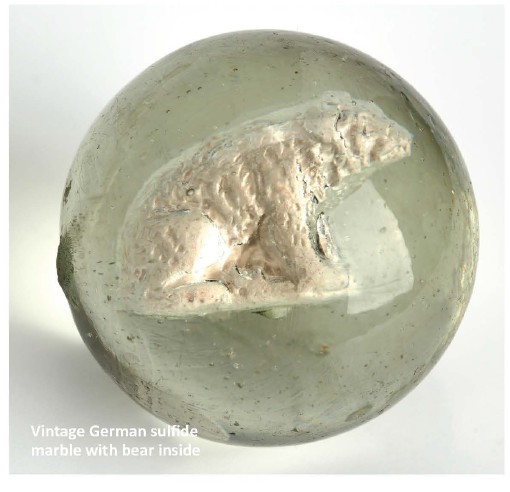
Among the most coveted finds are German sulfide marbles. These hand-made clear glass marbles, produced during the same era, contain a tiny porcelain figurine - often an animal, holiday motif, or notable person - suspended inside.
A rare figurine, such as a specific dog or character, can make a sulfide worth hundreds or even thousands of dollars. Newer sulfides made from the 1980s onward typically contain plastic figurines and are far less valuable.
Beyond sulfides, collectors prize a wide range of styles: cat’s-eyes, onion skins, swirls, aggies, clearies, and many more. With so many varieties, it’s worth taking a closer look at any marble you find on the beach - it might be more collectible, and more valuable, than you think.
I’ve been fortunate to find several marbles in and around Galveston and the Texas City Dike. Only one is fully frosted; the others show varying degrees of wear, chips, and conditioning.
One of my favorites is a large shooter marble with a stripe of uranium glass that glows brilliantly under a black light.
Most beachcombers eventually wonder how marbles end up on the beach in the first place. One popular myth claims that marbles were used as ballast in ships, but that’s unlikely - rocks or sand would have been free, abundant, and far easier to dump if a vessel needed to lighten its load.
That doesn’t mean marbles never traveled by sea. If a steamship carrying marbles as cargo sank, its contents could spill and eventually wash ashore. Storms and hurricanes can also churn up old debris and carry marbles onto beaches.
There are plenty of land-based sources too: vintage stop signs that once used marbles as reflectors, rusted spray cans that release the mixing marble inside, old soda bottles designed with a marble closure, and of course, kids playing with marbles along the shoreline.
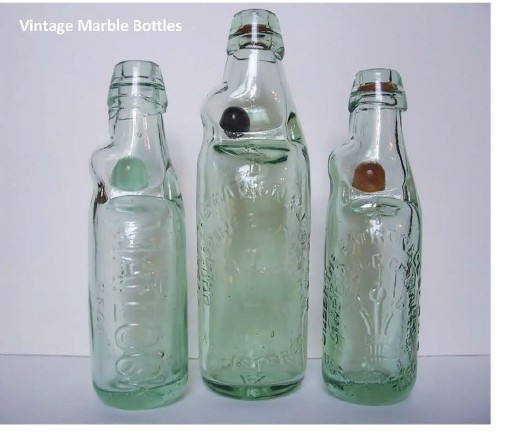 All of these can contribute to the mysterious appearance of marbles in the sand.
I wanted to learn a little about the history of how marbles were played. The game of marbles has been around for hundreds of years, and the basic rules have stayed remarkably consistent.
Locally, it was especially popular from the 1910s through the 1940s, and many of those games were played right on the beach. All kids needed was a circle drawn in the sand, and they had a ring ready for a pocketful of marbles.
There are two easy-to-learn marble games. The first is Ringer, usually played with two players.
A circle is drawn in the sand using a stick and a loop of string - poke one stick into firm, compacted sand (a retreating-tide area works well), loop the string around it, and use a second stick to draw the ring. Each player antes the same number of marbles, placing them inside the circle in the shape of an X.
Players take turns shooting their shooter - a larger marble - into the ring, trying to knock marbles out of the circle. Any marble you knock out, you keep.
That’s where the phrases “losing your marbles” and “having all the marbles” come from. Kids also had to learn to “knuckle down,” the classic shooting stance.
Ringer tournaments are still played today. The National Marbles Tournament is a nationwide competition for children ages 7 to 14, and “Ringer Stadium” on Wildwood Beach in Wildwood, New Jersey, has hosted the event for more than a century - though the games are now played on platform rings rather than beach sand.
The second game is called Plums. Two parallel lines are drawn in the sand, and each player places the same number of marbles on their line.
The goal is simple: shoot your opponent’s marbles off their line. As in Ringer, any marble you knock off, you keep.
Marbles are beginning to regain popularity after years of declining interest. It makes you wonder: is it time for Galveston to host its own marble tournament again?
With our beaches, our history, and our community of dedicated beachcombers, it wouldn’t take much to bring the tradition back.
One thing’s for sure - a lot of beachcombers wouldn’t mind finding a few more lost marbles in the sand.