 Galveston’s history has been documented through the photographer’s lens since before the Civil War. Some of the images, including an image of Central Wharf circa 1861 and stereographs created by Galveston photographer P.H. Rose in the mid-1880s, were featured in a 2018 exhibit at Rosenberg Library, a treasure trove of history located at 2310 Sealy Avenue.
Now, local photographer and author Pat Jakobi explores many of the men and women who turned their lenses on the island in her upcoming book, Early Galveston Artists and Photographers: Recovering a Legacy (The History Press), available March 8.
“The Progressive movement of the early 1900s, coupled with Galveston’s efforts to recover from the 1900 storm, inspired artist and society leader Maria Cage Kimball to suggest that the empty walls of homes and schools should be filled with art so that people ‘could be trained to [see] the true and beautiful,’” says Jakobi, a resident of the island since 1987.
“The young supervisor of drawing in the city schools, Frances C. Kirk, took that idea to heart and banded local artists together into what became the Galveston Art League (GAL),” Jakobi explains. “Artists in the League supported each other, showed their art in local settings, and brought artworks from eastern museums and galleries to Galveston exhibitions.”
The annual Cotton Carnival and Expositions in the early 1900s which highlighted the importance of cotton and cotton products to the economy, also gave local artists a place to showcase their work. By the 1920s, local artists and photographers had created a mutually supportive local art scene.
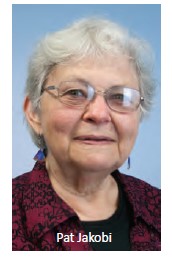 “That scene has had its ups and downs since then,” says Jakobi, “But it is still around, with galleries and individual artists cooperating in such activities as ArtWalk, shared social media, and art education and training opportunities for residents of all ages.”
Jakobi is herself active in the GAL, and that passion planted the seeds for her forthcoming book. “I volunteered to write a brief history of the of the Galveston Art League which was founded in 1914,” she explains.
“That ‘brief’ history turned into a 400-page compendium of artists who had shown in Art League exhibits over the organization’s first century.”
“I was fascinated by the number of artists who had achieved local and regional acclaim in the early days of the League’s history—artists whose works were exhibited in major art museums in Texas and even in other states, but for whom I could locate only one or two existing pieces,” Jakobi says.
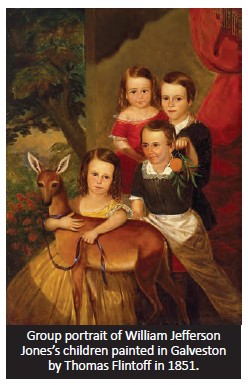 She wondered: What happened to the hundreds of other paintings and drawings that they created?
“I started looking for them and that led me to add early photographers to my search as well, since they played such an important role in providing employment and studio space for so many of the painters,” she says.
Her journey through Galveston’s photographic history revealed some unheralded talent including Lucius W. Harper, an African-American painter and photographer who worked in Galveston most of his life (1867-1920).
“The scant records I’ve found indicate that he was a respected member of Galveston’s Black community, but when he died, he was buried in what was then known as New Potter’s Field, now the Municipal Cemetery,” she says.
“However, his work has been resurrected. His lovely photograph of his son Amos all dressed up for school is part of the collection at the Smithsonian’s National Museum of African American History and Culture.”
Jakobi’s final result is a 144-page paperback which includes 56 images, 32 of which are color images in a center insert. The book begins with 19th century naturalist John James Audubon’s description of Galveston as a “rough village,” and follows through to the Great Fire of 1885 which burned hundreds of homes across 40 city blocks, to the catastrophic 1900 Storm that raked the island, through World War I and the 1918 Spanish Flu epidemic, to World War II.
She explains, “In trying to decide how to break the narrative into chapters, I realized that catastrophe was an exceptionally good motivator of change, mostly because of the need to rebuild or reconsider goals and purposes.”
For more information, visit www.JakobiPhotography.com or email Pat directly at PatJakobi@comcast.net.
Early Galveston Artists and Photographers: Recovering a Legacy (The History Press), $21.99
Available March 8 at Galveston Bookshop (317 23rd Street), Galveston Art League Gallery (2117-A Postoffice Street), and online at Target, Barnes and Noble, and Amazon.