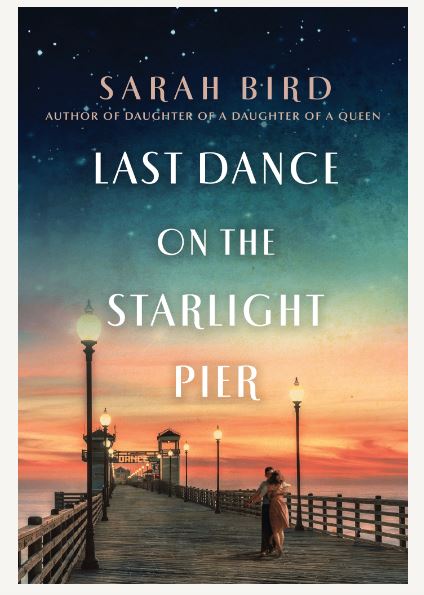
Blending the enthralling world of dance marathons during the Great Depression, with characters based on famous Galvestonians from the 1930s, “Last Dance on the Starlight Pier” by award-winning author Sarah Bird might just become one of the most popular beach-reads of 2022.
Readers will find familiar landmarks and characters that seem no-so-vaguely familiar in the work.
“The story opens after the last dance, and something devastating happens. The book is basically the story of the main character remembering how she ended up shivering, watching the Starlight Pier burn,” Bird said.
Bird is no stranger to historical fiction. The two-time recipient of the Best Fiction Award and a Lifetime Achievement Award from the Texas Institute of Letters already has several screenplays and 11 mainstream novels to her credit. But “Starlight Pier” is different, in that it comes from inspiration of her own family’s stories.
 Her mother Colista Marie McCabe shared tales with her about her youth.
“She was a fabulous storyteller who grew up on a struggling Indiana farm, and her father died during the height of the Great Depression,” the author said. “My mom had a gift for putting a laugh into everything, no matter what it was.”
“One of her fondest memories of what must have been an unimaginably tough time was when a version of the dance marathon came to the little grange hall in their small farming town. She talked about it like it was the most fun thing that had happened during this grim time and made it sound like a sort of slumber party where all the cool kids got to stay up all night,” Bird said.
“They brought picnic lunches to share and would cheer on the locals who entered the contest. So that was my impression of the dance marathon.”
Dance marathons, an American phenomenon of the 1930s, were endurance contests in which couples danced virtually non-stop for hundreds of hours, competing for prize money.
Bird’s view of these events was challenged when she saw the movie “They Shoot Horses, Don’t They?” in 1969. The dark depiction of Depression-era dance marathons and the people involved were at odds with the innocent, light-hearted experiences her mother had described.
“That’s where the seed was planted. I just felt like there was more to the story than what the movies portrays,” she said.
“Once I started doing research, I was astonished by how much there was to know about dance marathons, and how almost completely they have vanished from popular consciousness given how popular they were. At their height they employed 20,000 employees every week who worked around the country that included entertainers, nurses, judges, promoters, and ‘sloppers’ (the people who fed contestants). A dance marathon was held in every city in America that had a populations of over 5,000, in addition to the dinky ones like my mother saw.”
 Bird said she found a scholarly work about the phenomenon by Carol Martin, a professor of drama at New York University’s Tisch School of the Arts. Her 1994 book, “Dance Marathons: Performing American Culture of the 1920s and 1930s,” provided Bird with interviews of marathon participants and photos from private collections that do not exist in other archives.
It was one of those photographs that determined the setting of ‘Starlight Pier.’
“She (Martin) had a very clear photograph of a marathon taken at the Galveston City Auditorium, which is no longer there, taken on September 19, 1930,” Bird said.
“Of course, I was aware of the history of Galveston in the 1930s and what an incredible gift to a novelist that is. We can’t make up anything as good as Galveston in the ’30s.”
With the setting decided, she developed a heroine based on her own mother, a Methodist farm girl who was eventually adopted by Catholic nuns who found a place for her in a Catholic nursing school.
“I had all my mother’s wonderful stories about her first encounters with Catholicism and about first seeing Catholic artifacts, like the bleeding hearts,” she said.
“I also knew that my heroine was going to be a nurse because I don’t think there’s an interesting way to write a novel about a dance marathon from the point of view of a contestant. They were only on the dance floor so didn’t see what was going on behind the scenes. Galveston was such a center of medical training and had the fabulous St. Mary’s training school for nurses, so I used that as well.”
Bird emphasized that, although some of her characters are based on Galveston personalities, her story is not meant to be construed as history.
“The history of Galveston is very well-documented, which is good and bad from the point of view of historical novelists in the sense that I wasn’t writing about the history of Galveston. I had to create a family that was like the Maceos but not the Maceos.”
The writer is aware of the two recent contradictory books about the Maceo family, and she said she has had “lively discussions” with BOIs (people “Born on the Island”) whose opinions fall on both sides of what has been written.
“That’s another reason I would never use the actual family name or claim that my characters were the Maceo brothers. They served as a fictional model that I could play with because what they did was almost inconceivable,” she said.
“The big climax takes place on something I call the Starlight Pier, which is loosely based on the (original) Pleasure Pier. I used history when it fit in, and when it didn’t fit, I changed it. But I didn’t disturb timeline landmarks, including how the story pivots around is the nomination of FDR (Franklin Delano Roosevelt) in the summer of 1932.”
Events in the timeline of the story were synchronized with true historical events. She also took into consideration “all of the things that would or would not have been in my character’s world and the kind of language she would have used.”
The discovery that made the biggest impression on the author during her research about Galveston was “how beloved the Maceos were—how universally accepted and admired, and how much their glamour and cache has survived to this day as has the nostalgia for the more glamorous time that they represented.”
“Starlight Pier” took the author about four years to complete. She had finished a year of research just as the pandemic hit, allowing her to stay home and concentrate on her project.
When asked how much she writes on a typical day, she responded with a smile. “Can I just say ‘not as much as I should?’ When I walked out of a windowless office job after one year, I made a promise to myself that I don’t ever want to know exactly what I’m going to do every day when I wake up. I might have taken that to an extreme.”
Bird said she hopes to visit Galveston again soon to help celebrate her latest work.
“I love talking to people from Galveston. They have a sense of pride and identity about the island because of the incredible hardships the island has endured, the sense of innovation of the people, the influx of immigrants and a lot of visionary people for that time. There’s a lot to be proud of in that heritage.”
“Last Dance on the Starlight Pier” is set for release on April 12 and will be available at the Galveston Bookshop or amazon.com.