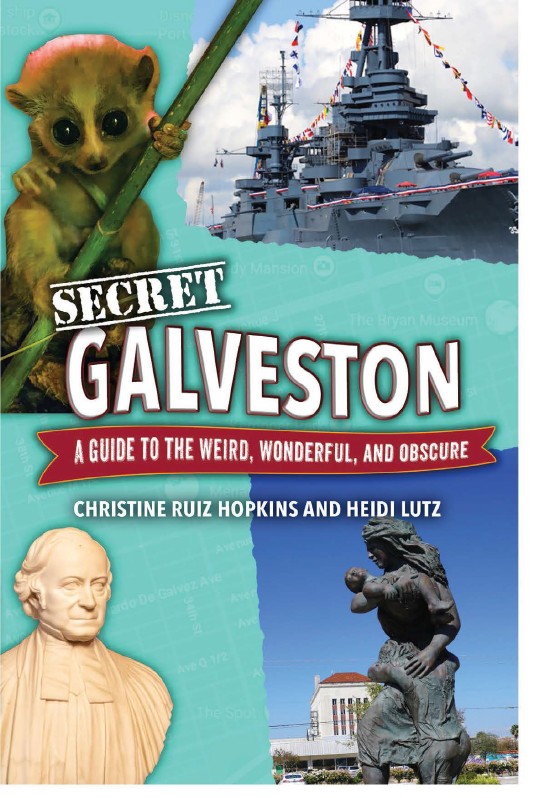
 Shhhh… some of Galveston’s best-kept secrets are about to be revealed. In Secret Galveston: A Guide to the Weird, Wonderful, and Obscure, authors Christine Hopkins and Heidi Lutz shine a light on the island’s hidden corners - the stories, places, and curiosities even longtime locals may have missed.
Their new book gathers favorite haunts and little-known gems from across the island, and you won’t want to be the only one who isn’t “in the know.”
Secret Galveston marks the duo’s second collaboration, following the 2020 release of 100 Things to Do in Galveston Before You Die. Hopkins has promoted Galveston for more than 30 years, hosted several island video series, and serves as co-host and producer of Galveston County Museum’s Unboxing History.
Lutz is an award-winning writer and designer whose career has included reporting, editing, publicity, blogging, tour guiding, and deep community involvement.
Each entry in their new book spans about two pages, paired with photos, making it an easy, engaging read - the kind you can open anywhere and instantly learn something surprising about the island you thought you knew.
“We sat down at The Gumbo Diner about a year and a half ago,” reminisces Hopkins, “and started coming up with our list. We knew (from the publisher) that we needed 84 topics, and we came up with a bunch of them by just brainstorming. We looked for lesser-known facts, like things we felt we knew or had heard of that we could look into further.”
Lutz says the heart of the project wasn’t just unusual places, but the people behind the stories.
“The weird, wonderful, and obscure in Galveston doesn't necessarily have to do with a place, architecture, monument or anything,” she explains. “It's all of these stories and most of it comes down to the people who have inhabited this little sandbar for over a hundred and fifty years.”
Researching those stories proved to be its own challenge. “We knew most of the stories, but we had to have references for this book,” Lutz adds.
“So it was challenging to think, ‘I know this story, but is it in a place that we can document as a reference that's legit and not just Joe Bob on Facebook posting it.’”
Once they had their list, the work became a true partnership.
“Once the topics were listed,” says Hopkins, “we were able to split the work down the middle, so of the 84 topics, we each took half.”
Along with the challenge of gathering resources and writing each entry, the duo also had to make sure every topic - no matter how compelling - fit within the publisher’s strict two-page format.
“There were a lot of stories that, even though we knew about them,” shares Lutz, “We learned a little bit more.”
That deeper dive only strengthened their connection to the material. “You really gain an appreciation for the places and stories the more you find out about them,” adds Hopkins.
Their book uncovers lesser-known stories from across Galveston, giving readers a chance to explore both physical and historical hidden gems.
When asked if she had a favorite “find,” Lutz doesn’t hesitate. “It’s not so much a secret, but it's also not open anymore. My favorite has always been the 20th-floor observation deck in the ANICO (American National Insurance Company) tower,” she says.
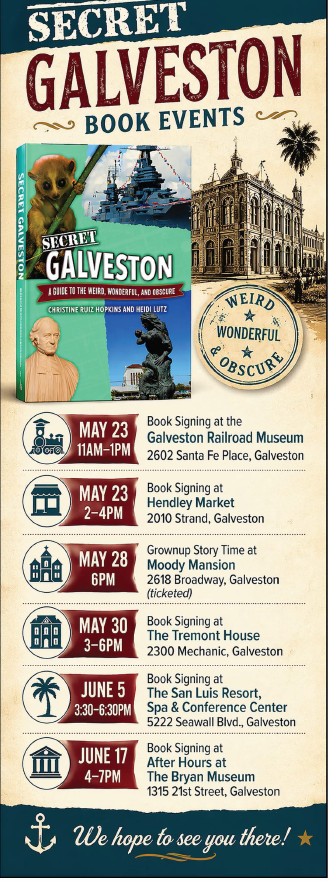 “I love that space and the stories told up there. But I also love the Hendley Market, and it is somewhat of a secret because it's not among the bulk of little boutiques on The Strand, from about 22nd to 24th Street.”
For Hopkins, the joy came from discovering how different eras and stories connect. “I was involved with the dedication of the Hope sculpture, which was Doug McClain's interpretation of Pompeo Coppini's original piece Victims of the Galveston Flood. Coppini also designed the grave of General Magruder and a memorial in Lakeview Cemetery. And the Hope sculpture was even the inspiration for the new mural at The Bryan Museum.”
The pair found themselves genuinely delighted by the discoveries each uncovered along the way.
“I lived around the corner from the old Purity Ice Cream Factory,” says Lutz, “and ever since I moved to Galveston, I have known you can still get Purity ice cream made upstairs at La King's.”
But in researching the book, she stumbled onto a piece of the factory’s history that surprised even her.
“There was a piece of machinery that automatically shut off the machinery at night, and it broke. Instead of fixing it, the owner decided to hire local teachers, who weren’t making much, for the afternoon and evening shifts,” she says.
“They would have a job where they could sit and sell ice cream in the neighborhood after dinner, and grade papers at the same time. So they were there to shut off the valve at night. The owner could have fixed it, but chose to hire teachers instead.”
The pair found themselves just as fascinated by each other’s discoveries as they were by their own.
“That's a great story,” agrees Hopkins. “Something I learned from reading Kathleen Maca’s and Kimber Fountain's books and articles is that we became such a tourism destination largely because of the Maceos and their hiring a promoter who came up with the Pageant of Pulchritude, Oleander Festival, and the parades. Their Hollywood Dinner Club was one of the first air-conditioned nightclubs.”
Lutz notes that many of those early influences still echo through the island today. “And those are pieces of history you can connect with in modern times,” she points out.
“One of the family businesses, Maceo Spice, is still open, where you can eat the original Maceo gravy that was made in the famous Hollywood Dinner Club.”
Hopkins adds that some stories remain beloved because they bridge past and present. “We wrote about the margarita, of course,” she says, referring to Galveston’s claim as the home of the original version of the cocktail.
“The places connected with it - The Balinese and Old Galveston Club - are gone, but you can still order a margarita at the new Old Galveston Club. So those things are kind of fun and interesting to people.”
Not every story in the book is about success, though - and some of the lesser-known failures are just as compelling.
“And then there were the things that were not so successful, like Nottingham,” states Lutz. Nottingham was a lace manufacturing and residential area developed west of the city in 1891.
“I love the Nottingham story, because they operated long enough to produce lace. It was supposed to be its own little city. They had a train going out there, a post office, their own zip code, and plots for houses for the executives and the workers. It was going to be a company town, until the 1900 Storm happened.”
Just as the authors were wrapping up the project during the editing phase, they realized they were one story short of the 84 required by the publisher.
“We couldn’t figure out how we had miscounted,” sighs Lutz. “We had a list - actually three lists - so we reached out to all of the people we knew, because we were drained of ideas at that point.”
Hopkins says the island’s deep well of local knowledge made all the difference. “We mention it in the book acknowledgments, but there are so many interesting resources that are unique to our island, and local experts we could text, email, or call for information. They made it a lot easier to write this book.”
Fortunately, the missing topic was found, researched, and added just in time for their deadline - rounding out a full collection of intriguing stories for readers to explore.
Hopkins notes that the book can also be enjoyed as a kind of scavenger hunt. “There are some places you can visit like the Galveston Railroad Museum, and even stay overnight in one of two different railcars. Or you can just pop around and see some of the things you just never noticed before.”
“Galveston is a welcoming community that has a quirkiness to it,” she muses. “But at the same time, there’s this incredible history and pride that you see when you talk to the people here, whether they are new to the island or have lived here a very long time.”
Readers can keep up with the authors and their personal appearances through their Facebook and Instagram accounts, both under the name Galveston By Locals. Secret Galveston, published by Reedy Press, will be available at local retail outlets and at special Secret Galveston events.
Hopkins adds, “We really hope that people will either come to a book event or purchase from a local shop because we want to support our local businesses as much as we can.”