The Battle of San Jacinto took place 190 years ago this April 21 and remains the decisive turning point of the Texas Revolution. When General Antonio López de Santa Anna led his troops into camp on April 20, he had no expectation of facing a full assault the next afternoon.
The Texian attack - launched with shouts of “Remember the Alamo!” and “Remember Goliad!” - shattered the Mexican ranks in minutes.
Santa Anna fled on horseback but was captured the next morning, eight miles from the battlefield, hiding in brush along Buffalo Bayou. Sgt. James A. Sylvester, part of a scouting party under Col. Ed Burleson, seized the disguised dictator and returned him to camp, where Mexican prisoners immediately recognized and saluted “El Presidente.”
He was brought before the wounded General Sam Houston, who lay beneath a large oak tree with a shattered leg. Vice President Lorenzo de Zavala confirmed the prisoner’s identity.
Houston, in agony, confronted Santa Anna about the massacres at the Alamo and Goliad. Shaken, Santa Anna accepted an opiate Houston offered to calm his nerves.
Under that tree, the two men agreed to an armistice and the withdrawal of Mexican forces - effectively sealing the fate of the Republic of Texas.
Houston soon learned that two additional Mexican armies remained in the field. He dispatched scout Deaf Smith to carry Santa Anna’s written orders to General Vicente Filisola, directing him to retreat toward Béxar and Victoria.
Several days later, interim President David G. Burnet arrived at San Jacinto by steamboat. Sensing Houston’s rising influence, Burnet accepted his resignation and transferred command to Thomas J. Rusk.
On the return trip to Galveston, Burnet attempted to deny Houston passage for medical care, but the Yellowstone’s captain, Thomas Grayson, refused to depart without him.
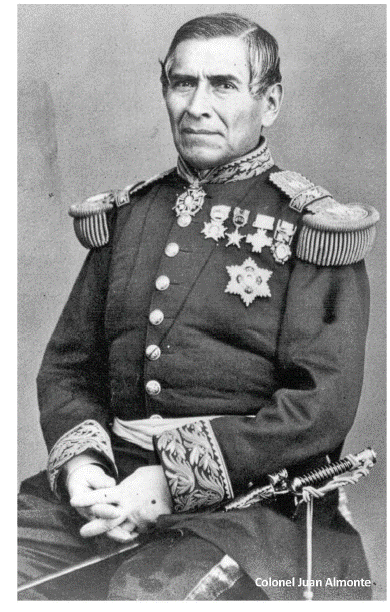
Burnet, his cabinet, Houston, Santa Anna, and three senior Mexican officers - Ramón Martínez Caro, Col. Gabriel Núñez and Col. Juan Almonte - traveled together aboard the Yellowstone under guard.
Almonte, Santa Anna’s educated and English-speaking aide-de-camp, was widely respected by the Texians and often acted as an informal intermediary during the prisoners’ confinement.
During the voyage, government agent Robert Triplett spoke with Almonte, who explained that the Mexican army had not been surprised, but overwhelmed by the ferocity and speed of the Texian charge. The Texians fired once, then closed in hand-to-hand with rifle butts and Bowie knives - fighting with a resolve fueled by the Alamo and Goliad.
Upon reaching Galveston, Houston briefly addressed the troops before being placed aboard the schooner Flora and sent to New Orleans for treatment, escorted by the Texas warship Liberty.
Burnet, his cabinet, the Mexican prisoners, and their guards continued down the coast to Velasco - present day Freeport - where the new Texas government re-established itself in May 1836.
Founded in 1821 as the port of entry for Stephen F. Austin’s colonists, Velasco had also been the site of the 1832 Battle of Velasco. The settlement, named for a Mexican general, sat on the east side of the Brazos River and consisted of roughly a dozen houses. Across the river, the tiny community of Quintana held only four houses and a small store.
Fort Velasco stood a few hundred yards inland, a circular earth-and-timber structure that now served as the temporary seat of government - on the site of what is today Surfside Beach.
Treaty of Velasco
The Treaty of Velasco, signed on May 14, 1836, set the terms under which Mexico was expected to recognize the Republic of Texas. Though commonly referred to as a single agreement, it consisted of two documents - one public and one secret - negotiated between the Texas government and Santa Anna, who signed on Mexico’s behalf.
Both sides understood that a treaty signed by a prisoner, especially a head of state, was not legally binding. Even so, the agreements proved effective in the short term.
The public treaty ended hostilities and required Santa Anna to order all Mexican forces to withdraw below the Rio Grande and refrain from taking up arms against Texas. By then, Generals Vicente Filisola and José de Urrea had already begun their retreat.
Santa Anna also pledged to restore confiscated property, and both sides agreed to exchange prisoners.
The secret treaty went further: Texas would release Santa Anna and transport him to Veracruz. In return, he promised to seek formal ratification of both treaties and negotiate a permanent settlement recognizing Texas independence and the Rio Grande as the boundary.
Santa Anna initially balked at signing the secret agreement, insisting his word should suffice. His hesitation sparked outrage within the Texian cabinet, and calls for his execution grew.
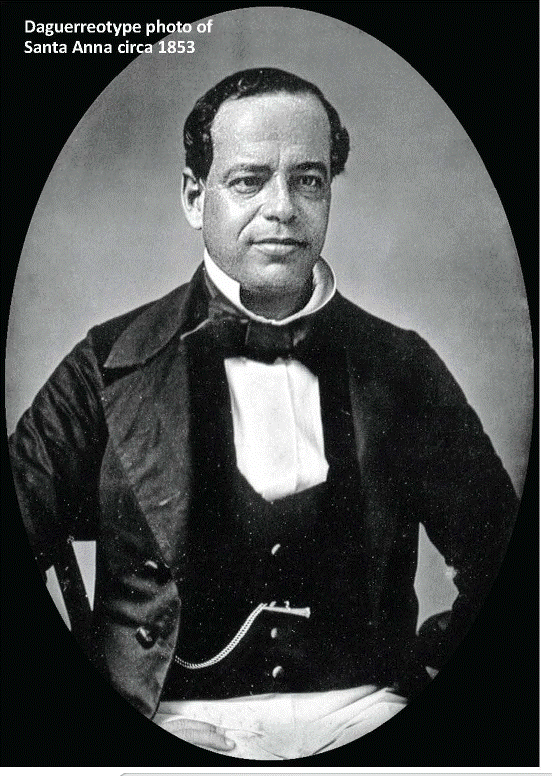 Realizing his life was in danger, he signed. At that moment, he was willing to endorse almost anything to avoid being shot.
A Controversial Release
The Burnet administration quickly lost credibility with both the army and the public when it agreed to release Santa Anna - the man responsible for the Alamo and Goliad. Vice President Lorenzo de Zavala served as interpreter during the drafting of the agreements.
To fulfill the secret treaty, President Burnet first ordered Commodore Charles Hawkins to transport Santa Anna to Veracruz aboard the Independence. Hawkins refused, declaring he would “sooner blow up my ship and crew” than return the dictator to Mexico.
Threats of court-martial went nowhere; Burnet knew punishing him would spark a political revolt.
The assignment then fell to Jeremiah Brown, captain of the Texas warship Invincible, who agreed to carry out the mission. On June 1, 1836, Santa Anna and three senior officers - Ramón Martínez Caro, Col. Juan Almonte, and Col. Gabriel Núñez - boarded the Invincible, which was preparing to sail for Veracruz.
Preparations paused while instructions were drafted for Bailey Hardeman and Vice President Lorenzo de Zavala, who had been appointed as commissioners to accompany Santa Anna to Veracruz. During this delay, the steamship Ocean arrived with more than two hundred New Orleans volunteers.
When they learned Santa Anna was aboard the Invincible, outrage erupted. Led by Thomas Jefferson Green, the volunteers stormed the ship and confronted the bedridden Santa Anna.
Terrified, Santa Anna swallowed a large dose of opium, enough that some feared he might die aboard the vessel. After determining he was fit to move, Green ordered him taken ashore in irons.
Facing the threat of mob violence, Santa Anna wrote a desperate letter to Burnet, begging to be shot aboard the Invincible rather than handed to the crowd.
Public fury forced Burnet to revoke his order for embarkation. As guards prepared to remove him, Santa Anna clung to the ship’s rails, screaming and pleading not to be taken ashore.
Moments earlier he had believed freedom was within reach; now he was being dragged back into danger.
Texian guards overpowered him, and Captain Brown personally accompanied the prisoner ashore. On land, the crowd roared for his hanging, but Green insisted Santa Anna be kept alive as a political asset.
As Brown’s gig crossed the harbor, townspeople, travelers, and volunteers gathered to watch. Santa Anna, trembling beneath the flag of the Texas Republic, removed his hat in a show of submission, bowing repeatedly as the boat glided past the murmuring crowd. Once out of sight, he collapsed into his seat, exhausted and visibly shaken.
Ashore Again in Velasco
After being removed from the Invincible, Santa Anna and his three fellow prisoners were taken by General Thomas Jefferson Green to a McKinney & Williams warehouse in Quintana for safekeeping until the mob in Velasco dispersed. Burnet placed Green in charge of their protection.
Three days later, the prisoners were returned to Fort Velasco and confined once again to the upstairs room they had previously occupied - the same building now serving as the temporary seat of government.
Around this time, Col. Juan Holzinger, a Mexican officer who had served under General Urrea, appeared in Burnet’s office under Texian escort to give a deposition as part of a prisoner exchange. He was accompanied by Herman Ehrenberg, a Prussian-born Texian who had survived the Goliad massacre and had later been recaptured by Holzinger’s unit.
During the meeting, Santa Anna entered under guard. Holzinger, who had once served under him, greeted the former president with a formal salute, and the two immediately fell into an animated exchange in Spanish.
Holzinger was released the next day and departed for New Orleans aboard the schooner Pennsylvania, traveling with Ehrenberg. Both men were Prussian, and with the war behind them, they formed an unlikely friendship.
Ehrenberg later recalled that Holzinger carried instructions from Santa Anna to the Mexican consulate in New Orleans. Expecting a prolonged stay in Texas, Santa Anna requested a silver coffee service, fine tableware, delicacies, and even a personal cook - luxuries he felt were lacking in Texian captivity. The consul refused to advance him any funds, and Holzinger left New Orleans without fulfilling the request.
An Escape Plot Hatches
Not long after Santa Anna and his officers were returned to Velasco, a Spanish wine merchant named Bartolomé Pagés arrived in town. Having spent most of the war in New Orleans dealing in wines, spirits, and horses, he now hoped to open a grog shop on the ground floor of Brown’s Tavern - the same building where the Mexican prisoners were held.
Pagés visited the family of Deaf Smith and was soon introduced to Santa Anna and his companions. Their proximity led to frequent conversations in Spanish, and Santa Anna’s secretary, Ramón Martínez Caro, quickly saw an opportunity.
Desperate to escape, Caro proposed that Pagés travel to New Orleans, secure funds through the Mexican consul, and purchase a ship and cargo as cover for an escape attempt.
If the plan failed, Caro intended to expose the plot to the Texians and win his freedom. Pagés, in turn, would claim he had merely tricked the Mexican government into financing a ship he planned to keep.
In their imagined scenario, both men would emerge as heroes - and Santa Anna would be left behind. With this self-serving plan in mind, Pagés departed Velasco carrying confidential correspondence from Caro.
Meanwhile, Velasco was becoming increasingly dangerous for the Mexican prisoners. Threats were common, tempers were high, and the government realized it could no longer guarantee their safety.
After a brief stay in Quintana, Santa Anna and his officers were moved by boat to Columbia and placed under guard in a small two-room house.
On the morning of June 27, while Almonte and Núñez were playing checkers, a drunken man approached an open window and demanded, “Are you Santa Anna?”
When Almonte replied that he was not, the man fired a revolver into the room, the bullet striking the wall between the two officers. Texian guards subdued the assailant immediately.
The incident made it clear that the prisoners could not remain in Columbia. Soon after, Santa Anna and the others were taken by steamer nearly thirty miles farther up the Brazos River to the farm of Dr. James A. Phelps.
The property - known as Orozimbo Plantation - became Santa Anna’s new place of confinement, where he remained under heavy guard through the summer of 1836.
The Mission to New Orleans
While Santa Anna and his officers were held in Brazoria, Bartolomé Pagés reached New Orleans to set the escape plan in motion. Cryptic letters written in Ramón Martínez Caro’s hand - carried by Pagés - were delivered to the Mexican consulate and to the Lizardi Brothers, confirming Caro’s involvement.
The Mexican consul proved receptive. According to Pagés, the consulate arranged a $4,500 loan through the Lizardis, which he used to purchase the Passaic, a small transport vessel with a single gun, a crew, a captain known as “Portuguese Joe,” and a cargo valued at about $2,000.
Pagés returned to Texas with the Passaic - and with two items that would later cause him serious trouble.
The first was a bottle of opium-laced liquor, purchased through intermediaries. His plan was simple: visit Santa Anna, drug the guards, and spirit the prisoners downriver to the waiting ship.
The second was a “letter of transit” from the Mexican consul instructing any Mexican warship or privateer to protect Pagés and allow the Passaic free passage into Texas ports.
Pagés later claimed the opium and the secret passport were needed to convince the consul the rescue plan was genuine. Caro, however, wrote in his memoir that he believed Pagés never intended to rescue Santa Anna at all - that he meant only to swindle the Mexican government out of a ship and its cargo.
But Pagés surprised everyone when he reappeared in mid-August at the Phelps plantation, where Santa Anna and the other prisoners were now held. He arrived among a group of curious visitors invited in by the guards.
Santa Anna remained a celebrity even in captivity, and locals treated the visit almost like an open house. Almonte, fluent in English, charmed the ladies; meanwhile, Caro maneuvered himself into a seat beside Pagés to revive their secret scheme.
Caro later described how he managed to whisper a question to Pagés despite orders that all conversation be in English. Pagés quietly admitted that his mission had collapsed - the crew he had hired for the Passaic had been taken from him, and the prisoners were now too far inland for any escape by ship unless they could be smuggled out by small boat.
Their exchange did not go unnoticed. A Texian sergeant fluent in Spanish overheard the whispering, pulled Pagés aside, and berated both men. Caro tried to claim he was merely ordering supplies, but the damage was done.
When Maj. William H. Patton returned to Orozimbo the next day, he questioned Pagés directly. The merchant’s evasive answers raised enough suspicion for Patton to order a search of the Passaic and its papers. Among them was the incriminating letter from the Mexican consul - confirmation that a larger plot was underway.
Texian authorities also discovered that a local Mexican boy had been recruited to secure a small boat to ferry the prisoners downriver to the Passaic. With the plot exposed, the government confiscated the vessel and placed Pagés in irons. The would-be rescuer - or would-be swindler - was now a prisoner himself.
A New Warship - and New Dangers
 On August 28, the captured Passaic was placed under the command of Capt. James Boylan, who was ordered by President Burnet to repair, supply, and sail the vessel from Velasco to Matagorda.
There it was rechristened the Texian schooner Viper and assigned to a privateering cruise south of latitude 24, empowered to board vessels of any nation and seize cargoes deemed lawful prizes.
Ironically, Ramón Martínez Caro - who had helped hatch the escape plot - was released for turning state’s evidence against Pagés. The Texian government even paid his passage to New Orleans, where he arrived aboard the schooner Colonel Fannin on September 29, 1836.
Meanwhile, Santa Anna and Colonel Almonte endured far harsher treatment. By order of Gen. Thomas J. Rusk, both men were shackled with ball and chain for fifty-two days during the summer of 1836. At the mosquito-ridden Orozimbo Plantation, Santa Anna brooded over his fate in the sweltering heat, sinking into deep despondency. Dr. James A. Phelps, the plantation’s owner, took a personal interest in his well-being.
On one occasion, Phelps saved Santa Anna’s life after the prisoner consumed a bottle of opium-laced wine that had slipped past the guards. Phelps acted quickly, pumping his stomach and pulling him back from the brink.
The dangers were not only internal: a band of armed men once arrived at the Phelps home intent on killing Santa Anna. Only the intervention of Mrs. Phelps - who threw her arms around the prisoner and shielded him with her own body - persuaded the would-be vigilantes to back down.
The Aftermath
When Sam Houston was sworn in as president of the Republic of Texas on October 22, 1836, he moved quickly to resolve the question of Santa Anna’s fate. The Mexican leader had now spent seven months as a prisoner of war, and President Andrew Jackson had privately urged Houston to release him.
While Congress debated, Houston quietly arranged for Santa Anna to be removed from Orozimbo under cover of darkness and taken to the United States. He was escorted by Major William H. Patton, George Hockley, Hamilton Bee, and Colonel Juan Almonte, while Colonel Núñez was released separately to New Orleans.
The party left the Brazos around November 25, traveling on horseback to the Lynchburg crossing of the San Jacinto - the same battlefield where Santa Anna’s fortunes had collapsed months earlier.
From there they rode through northern Louisiana to the Mississippi River, boarded a steamboat, and continued up the Mississippi and Ohio to Louisville, Kentucky, arriving on Christmas Day to curious crowds.
In Washington, Santa Anna’s arrival caused a sensation. Abolitionists greeted him as he passed through the city, and President-elect Martin Van Buren called on him at his boarding house.
Soon after, Secretary of State John Forsyth escorted Santa Anna and Almonte to the White House for a brief meeting with Andrew Jackson. Jackson then ordered Santa Anna released through the Mexican embassy for transport home.
He was carried back to Veracruz aboard the U.S. frigate Pioneer, bringing an end to his disastrous Texas campaign.
As for Bartolomé Pagés, the ill-fated wine merchant, his troubles continued. After a failed escape attempt - which prompted the first wanted poster issued by the Republic of Texas - he was recaptured and confined in a freezing, vermin-infested hut.
A desperate letter to President Houston brought no immediate relief, but Pagés was eventually released in New Orleans, arriving aboard the schooner William Bryan on April 24, 1837.
Unlike most of the thirty-plus passengers, he carried no luggage.