The original identity of the large white building at the corner of Twenty-fifth and Church Streets is betrayed by a “ghost sign” (an old, faded, hand-painted advertising sign on the exterior of a building) still visible on the north side, which reads “Model Laundry and Dye Works.”
One might assume laundry is a rather mundane occupation, but the history of this particular business is interwoven with notable chapters of island history involving technological revolution, immigration prejudices, forward-thinking building design, and labor disputes.
Keeping clothes clean in 19th century Galveston was nearly impossible until the "Cleanliness is Next to Godliness" movement took hold. Inspired by global health efforts, Galveston residents took action in June 1899.
Local women petitioned to remove trash from properties, while a new group - the Cleaner Galveston League - organized to make Galveston the “cleanest city in the South.”
Households that laundered their lace curtains, mosquito bars, and tablecloths often laid the items on the grass or across balconies contaminated with filth blowing in from the streets and alleys, which was far from sanitary.
Rising to meet the challenge was Model Laundry & Dye Works, but the story of their success did not come without a dark chapter. The movement toward a healthier and more sanitized city often targeted those who were viewed with prejudice.
The majority of laundries on the island at this time were operated by Chinese immigrants, who laundered clothing by hand during the day in virtually the same spaces where they lived and slept at night.
This segment of the population was considered “mysterious,” and national and international sentiments about the Chinese promoted distrust. That sense of suspicion was used by non-Chinese laundry operators as leverage against their immigrant competitors.
In addition to promoting its cutting-edge steam technology, Model Laundry was among the businesses that advertised itself as a “white man’s laundry,” claiming more sanitary practices than those used by Chinese competitors. It welcomed only white patrons and, in its early years, employed only white workers.
Professional laundry operations across the country used similar tactics, promoting the supposed health benefits of mechanical steam cleaning. Many paired their advertisements with harsh, racist caricatures, including cartoons depicting Chinese workers spitting on laundry while ironing.
When Model Laundry’s new facility opened in 1913, there were at least seven laundries operated by Chinese residents, including Wah Hong, Sing Hop, Sing Quong, Lee Sun, and Long Wah, each identified in the local directory with their race.
By the early 1920s, that number had declined, and the remaining businesses were held in low public regard, labeled as unsanitary and outdated.
The larger laundries promoted a clear message to customers: "Instead of bringing your clothes to a Chinese hand laundry, you should bring your clothes to an 'absolutely sanitary laundry' with 'healthy American people.'"
Within a 30-year period, the number of Chinese surnames appearing in Galveston directories dwindled considerably - a reflection of residents leaving in search of other opportunities, driven largely by prejudice.
Model Laundry - a business dating back to 1888 and the most successful laundry on the island - grew rapidly, moving from its Postoffice Street location to a state-of-the-art facility on 25th Street in 1913.
The new building was constructed almost entirely of reinforced concrete, which was considered more sanitary than wood and far more resilient in storms.
It was designed by influential architect Joseph Finger, an Austrian-American immigrant who relocated to Houston in 1905. Built with a concrete roof, beams and columns, and brick curtain walls, the structure was promoted as both fireproof and sanitary.
Finger framed the bays of the building in white glazed brick and tile facing, topping the structure with detailed parapets. Large windows illuminated the interior workspaces, and the facility included ten bathrooms for employees and five telephones for taking customer orders.
The laundry operated its own power plant, equipped with two coal-powered boilers, two gas-powered engines, and two electric generators.
Built for an astonishing $50,000 (over $1.5 million today), the two-story edifice was such a marvel that when the Rotary Club hosted an open house in April 1914, hundreds of residents attended to watch Model’s laundering process. Visitors were even served refreshments and given souvenirs.
Model’s cleaning process was considered progressive for the era. Items to be laundered were picked up from the homes, restaurants, or hotels of clients and brought to the facility to be marked with owner identification and sorted.
It’s amusing to note that during the first laundry run at the new plant, these markings had not yet been implemented, making identification after washing something of a puzzle. Many items were delivered to the wrong customers, but the mix-ups were resolved within a few days.
After marking, the laundry was sorted into clothing and flatwork (tablecloths, linens, towels, and rags). The items were then washed in revolving machines filled with water softened with neutral soda and Ivory soap flakes.
After eight or ten “waters,” the items were removed and fed through a wringer to extract the remaining liquid.
Flatwork was shaken out by hand and fed into an ironer made of heavy, padded rollers that revolved over a steam-heated chest. The rollers were equipped with safety guards to prevent workers’ hands from being caught between the cylinder and the chest.
After the flatwork came through the rollers, it was precisely folded by a specially trained team of girls who, if they were fortunate enough to be assigned to smaller items such as handkerchiefs, had wooden stools to sit upon.
 If a piece of paper appeared in the rollers, it signaled to the crew that the previous bundle was complete and that the next items belonged to a different customer. The folded bundles were then placed on a separate table for a sorter, who checked each piece against the customer’s original itemized list to ensure the order was complete.
Clothing that required starching was starched by hand, except for collars, which were processed by a small machine that rolled them through tubs of starch and water. The collars were then smoothed by hand and hung to dry in a steam-heated room.
Once the starched items were finished, they were sorted and packaged for delivery by Model’s fleet of 18 signature red trucks.
In addition to hosting open houses and acts of charity, Model Laundry connected with the community by forming its own baseball team in 1915. The team joined the Commercial Baseball League, facing rivals such as Rex Laundry and Sam J. Williams Clothier, and continued competing until the league dissolved in the early 1940s.
The company also understood the value of public relations. In 1922, it held an essay contest for domestic science students on "The Modern Laundry," drawing an impressive 78 entries for the $10 prize.
In
1926, Model Laundry installed a Permutit water-softening filter. By removing magnesium and calcium from the water, the company could use less soap and produce brighter colors - a chemical advantage over home washing.
By 1929, they had secured a Galveston-exclusive contract with Procter & Gamble to use Ivory Soap chips, leveraging one of America’s most trusted brand names.
The Model Laundry & Dye Works corporation was dissolved in 1928 and succeeded by Model Laundry, with officers W. A. Johnson, C. J. Michaelis (of Star Drugs), F. L. Coffey, and C. M. Hess. Its associated businesses, including Ideal Cleaners, were also reorganized into separate corporations.
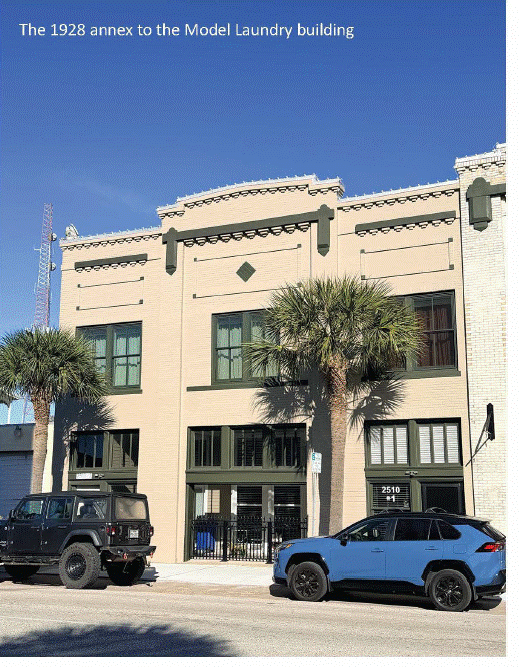
That same year, the new corporation added a two-story yellow brick annex, still easily identifiable on the south side of the building.
By the 1930s, the company offered “Certified Dry Cold Storage Vaults” to protect valuable furs from heat, humidity, and insects, and portions of these storage areas remain recognizable today.
During the Great Depression, the company’s famous red trucks were repurposed to deliver baskets of groceries to families in need at Christmas.
In 1932, the Ideal Cleaning Company - a sister operation - moved from its location on 25th Street between Avenues F and G into the same building as Model Laundry.
While African Americans were eventually hired - “colored women for wool pressers” in 1945 advertisements, for example - the work floor remained segregated for decades.
The 1940s brought a series of unionized labor strikes, including one in 1945 over retroactive pay raises and several one-day walkouts in the early 1950s. The disputes were ultimately settled, Model Laundry became fully unionized, and the company even provided life insurance for every employee.
 By 1969, Model employed 95 people, maintained an annual payroll of $285,000, and was profitable enough to invest in new equipment such as an automatic folder.
Ironically, technological advancement ultimately led to the company’s downfall. In the economic boom following World War II, household washing machines and dryers became affordable for the average family, eliminating the need to send daily laundry out.
At the same time, the fashion industry introduced synthetic fabrics like polyester, which were easier to wash and did not require the professional pressing or care that older materials demanded.
The company shifted its focus to industrial contracts, but commercial clients such as restaurants were also modernizing, replacing traditional linens with disposable paper tablecloths and napkins.
In 1972, the business was sold to its longtime rival, Uneeda Laundry, and by the following April, Model Laundry ceased to exist.
But the legacy of the Model Laundry building refuses to be washed away. It has been listed on the National Register of Historic Places for both its architecture and its significance to community history.
Today, it houses businesses and residential lofts, standing as a reminder of a time when clean clothes - and the technology that made them possible - were considered nothing short of miraculous.