Known today as the Gill-League Building, a substantial three-story structure once stood on the southeast corner of 21st and Market for eighty-one years. Its upper floors housed a steady rotation of apartment residents, while the street level offered a changing lineup of local businesses - shoe stores, barbershops, restaurants, seamstresses, beer parlors, and eventually even a lawyer’s office and a popcorn stand.
Although the building was ultimately demolished in the name of progress, it left behind a long trail of stories. The people who lived and worked there, and the businesses that came and went, together form a vivid chapter in Galveston’s commercial history.
John Charles “J.C.” League (1850-1916) was a Galveston native and the younger brother of Thomas Jefferson “T.J.” League, the local entrepreneur who built the historic 1871 Thomas Jefferson League Building that still stands at 2301 Strand.
J.C. League had a sharp instinct for real estate and development, building a considerable fortune along the Texas coast without attaching his name to many formal business ventures, aside from a brief period in the hardware trade.
His obituary in the Galveston Daily News described him as a “pioneer” of the city and counted him “among the wealthiest and most prominent citizens in the city.” A lifelong resident, he died at his home at 1710 Broadway on January 13, 1916, at age 65.
Despite his many local investments, his most enduring legacy may be the founding and development of League City, located thirty miles north of Galveston.
Charles William Gill (1858-1924) was born in West Virginia and began his education and early business career in Springfield, Illinois. After two years at Northwestern University, he spent eight years working as head chemist for several pharmaceutical companies.
Gill first visited Galveston in 1882, the same year he married Esther League, daughter of T.J. League and niece of his future business partner. He became a permanent resident in 1886 and soon began investing in local enterprises and real estate, setting the stage for the partnership that would eventually give the Gill-League Building its name.
The two men were related by Charles’ marriage to Esther, and soon after became neighbors when the Gills moved less than a block away, into their home at 1818 Broadway. Both men were also members and vestrymen of Trinity Episcopal Church and well-known in the elite circles of Galveston for their individual philanthropy and dedication to the growth of the city, but their mutual interests culminated in 1892 with the design and construction of the Gill & League Building.
Listed with an address of 2025-27 Market Street, the Gill & League Building was designed as a multi-purpose urban structure. The three-story building featured several retail spaces on the ground floor and apartments on the second and third. City directories and tax rolls show it appearing in the 1893 listings, meaning construction likely began in late 1892.
Stylistically the building was considered Georgian colonial, a wide-ranging English architectural genre from the 1700s that enjoyed an American revival in the late 19th century; the style is defined less by a specific artistry or aesthetic and more by a penchant for symmetry and calculated proportions.
The structure spanned two Market Street lots, which explains its unusually long façade and ability to house multiple storefronts.
Although the Gill & League Building was a substantial mixed-use structure - with multiple first-floor storefronts and apartments on both the second and third levels - the precise interior layout, including specific room and bathroom counts, cannot be verified through publicly available insurance or architectural records.
What is well documented is that the ground floor housed several commercial bays, and early tenants represented a wide range of small businesses. Among the most notable early occupants were the Knights of Pythias of Galveston, who maintained their headquarters in the building, and members of the League family, including Thomas Jefferson League Jr., who operated a meat business in the Market Street commercial district during the same period.
When the Galveston-Houston Electric Railway began service in 1911, the fifty-mile interurban line connected the two cities in less than seventy-five minutes and quickly became one of the region’s most celebrated modern conveniences. The railway’s popularity helped give rise to one of the Gill & League Building’s best-known businesses, the Interurban Queen.
Opening in 1913, the shop combined a soda fountain, drug store, confectionery, magazine stand, and cigar counter, becoming a favorite stop for both locals and travelers throughout the railway’s twenty-five years of operation.
The building’s other notable claim to fame is its connection to Douglas “Wrong Way” Corrigan, the aviator who became a national sensation in 1938 after his now-legendary “accidental” transatlantic flight. After informing New York flight control that he was bound for California, Corrigan instead flew solo to Ireland, later blaming the detour on “faulty gauges.”
Galveston embraced him as a hometown hero, and on August 27, 1938, the city hosted a parade in his honor. The procession paused at the corner of 21st and Market, where Corrigan visited the third-floor room in which he had been born.
A bronze plaque had been installed to mark the spot, and although Corrigan initially protested that he thought he’d been born in a hospital, he was quickly corrected by the nurse who had attended his birth. He laughed at the revelation and conceded with good humor, “Well, you ought to know.”
By the early decades of the twentieth century, ownership of the building appears to have consolidated under the Gill family, likely following the death of J.C. League. This shift is reflected in the gradual disappearance of the League name from public references; from this period until its demolition, the property was almost universally known simply as the “Gill Building.”
After the death of Charles W. Gill in 1924, his son, Charles Jr., organized the Gill Corporation to manage and oversee the property.
In 1948, after assessing the building’s aging condition, the Gill Corporation announced plans for a complete renovation. In the January 28 edition of the Galveston Daily News, Editor Thomas G. Rice praised the decision, noting that the family had chosen to restore the structure “instead of disposing of the property 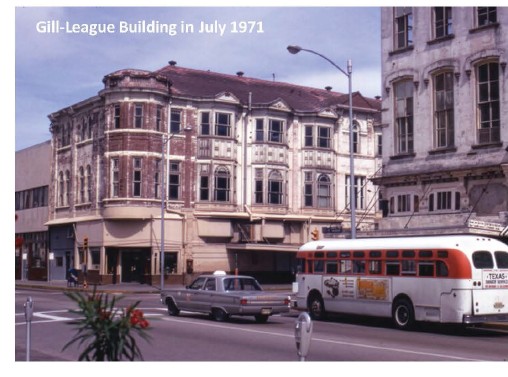 with the possibility the new owners might replace it with a modern structure, or remodel it beyond recognition.”
The renovation repaired the exterior, added woodwork, Austin stone, and new awnings to the upper windows, and reconfigured the first floor into more practical commercial space, including the installation of new terrazzo flooring.
The upper floors were remodeled into modern, air-cooled office suites, attracting new tenants that included a dentist’s office, a florist, and the Verkin Photograph Company.
By the late 1960s, the building’s last major tenant was a small furniture and appliance retailer that occupied the Market Street bay. When the store closed, the property sat vacant for several months, appearing in newspaper classifieds as “available” throughout mid-1972.
Its future changed later that year when the American National Insurance Company (ANICO) - owned by the Moody family - purchased the property in late 1972. Having recently completed their nearby high-rise headquarters, the company was seeking additional parking for its growing workforce.
A small group of local preservationists protested the possibility of demolition, but with no preservation ordinance in place at the time, their objections carried no legal weight. With no regulatory barriers, ANICO moved forward with its plans.
Citing the building’s deteriorated condition and the risk it posed to neighboring structures, ANICO ordered its demolition in April 1973. The bricks were salvaged and sold to the public, reportedly for ten cents apiece.
During demolition, the plaque commemorating Corrigan’s birthplace was removed and preserved. It survives today in a private collection, though it is not publicly displayed.