Some of Galveston’s most meaningful history can be found not only in the buildings that remain, but also in the ones that have disappeared. The origins of the Masonic Fraternity may be debated by historians, but its connection to Galveston’s earliest years is unmistakable.
Samuel May Williams - a Mason and close business associate of Stephen F. Austin - was among the founders of the Galveston City Company in 1838. Soon after the city received its charter, Williams and several other Master Masons petitioned for a dispensation to form a lodge.
Although approval was granted, the lodge did not organize immediately, likely delayed by the waves of disease that swept through the young city.
On June 5, 1839, the group finally assembled and adopted the name Harmony Lodge No. 6. The following year, the lodge received its formal charter, thanks largely to Williams, who gathered and updated the necessary records for presentation to the Grand Lodge.
From the beginning, the members hoped to build a lodge of their own, though it would take more than forty years for that vision to take shape. In 1848, Harmony Lodge purchased two lots at the corner of 21st Street and Postoffice, and in 1850 the first steps were taken toward constructing a temple that reflected the traditions of the Masonic Fraternity.
Progress stalled, however, and although a cornerstone was laid in 1856 during the annual session of the Grand Lodge of Texas, the project again came to a halt. The cornerstone remained partially buried on the vacant site for another twenty-six years, as the Civil War and its aftermath slowed major construction across the island.
At last, on June 12, 1882, Harmony Lodge appointed a building committee. Nicholas J. Clayton - already emerging as Galveston’s most celebrated 19th-century architect - was selected to design the structure, and George Locke & Co. was awarded the construction contract.
On December 14 of that year, the long-forgotten cornerstone was exhumed and re-laid in a ceremony officiated by Deputy Grand Master W.H. Nichols, whose father had presided over the original rite in 1856.
Built for the considerable sum of $57,000 - roughly $2 million in today’s dollars - the new Masonic Temple was funded through the combined efforts of several Masonic bodies in Galveston, each holding shares in the building and represented on a board of directors overseeing its construction.
A dedication ceremony was held on April 17, 1884, and was hailed as “an event most important in the history of Masonry,” drawing attendance from the Grand Commandery of Knights Templar of Texas.
When it was completed in 1884, the Masonic Temple at 21st and Postoffice stood as one of Nicholas J. Clayton’s most distinctive works, combining Gothic and Italian Renaissance elements in a style seldom found elsewhere in Galveston.
With its plaster buttresses, Gothic tracery, and balanced classical massing, the building quickly became a downtown landmark - anchored visually by a prominent corner tower that rose an estimated 120 feet, surpassing even the tower of City Hall and dominating the 19th-century skyline.
But as magnificent as the building was, its tenure was marked by hardship. The 1900 Storm destroyed the tower and damaged the north and west façades, though a full restoration was achieved. The 1915 storm brought further destruction, and this time only the interior was repaired; much of the exterior ornamentation was removed.
The 1920s brought a series of fires, around the time the ground floor had been leased for commercial use. One blaze damaged the upper floors, and while repairs were underway, another fire broke out, gutting the structure.
During the 1928 fire, Masons rushed into the burning building to salvage what they could. According to the Galveston Daily News, they carried out books, furniture, and even a grandfather clock.
Most remarkable of all, the building’s Italian marble staircase was removed piece by piece, cleaned, and later installed in the new Scottish Rite Cathedral at 22nd and Church, where it remains today.
The Masons rebuilt once more, restoring the building enough to continue meeting there, and Harmony Lodge resumed its activities.
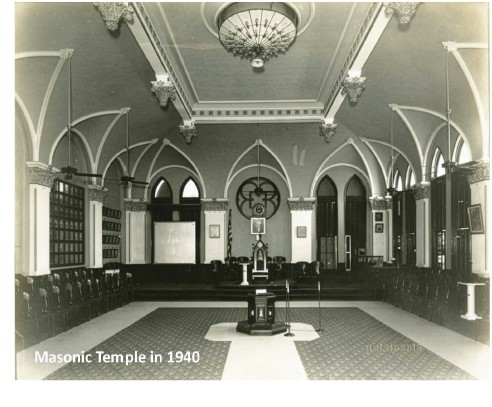
All remained stable until the night of January 13, 1942, when Harmony Lodge unknowingly held its final meeting in the building. Between 11pm and 4:30am, a catastrophic fire swept through the temple, consuming nearly everything.
In a detail still remembered by longtime members, an American flag hanging from a pole at the center of the building survived the inferno completely untouched. After the 1942 fire, the lodge and the temple’s board made the difficult decision to relocate.
Only the foundation and lower floors were restored, and the entire building was then leased to the A-B-C Racket Store, which had occupied part of the first floor since 1922.
 The A-B-C Racket Store, a long running variety and household-goods retailer, remained in operation within the surviving shell of the temple for another two decades. Archival invoices preserved in the Rosenberg Library show the store serving prominent Galveston families well into the 1950s, offering everyday necessities ranging from staples to household filters.
But on January 13, 1966 - exactly twenty-four years after the lodge’s final meeting - a final and devastating fire sealed the building’s fate. The damage was too extensive to justify repairs, and the structure sat charred and vacant until early 1967, when the Masonic Temple Association awarded the contract for its demolition.
The cornerstone survived and has remained under the faithful care of Harmony Lodge No. 6 through three relocations. Today it rests just inside the gate of the Scottish Rite Building at 2128 Church.
The site of the former temple is now a parking lot, and no structure has risen there since the last remnants of the original building were cleared away. In a fitting tribute to the organization so deeply woven into Galveston’s formation, the footprint of the Masonic Temple remains open ground - its absence a quiet reminder of the grandeur that once stood there.