Few passengers aboard the Bolivar Peninsula Ferry who glance east toward Pelican Island and the half-sunken SS Selma realize that the crumbling concrete ship was once home to a quirky Galvestonian.
Known as the “Hermit of Galveston,” Clesmey Noleska LeBlanc purchased the derelict vessel and retreated to its weathered decks to escape, in his daughter Celina LeBlanc Guyewski’s words, “wine, women, and taxes.”
His earlier life gave little indication of the eccentric legacy he would leave behind. Born in 1876 in Youngsville (then Royville), Lafayette Parish, Louisiana, LeBlanc was one of twelve children raised by French Acadian farmers Antoine Dupre LeBlanc and Celina Aspasie Broussard.
By age 33, he had married a local woman named Bertha Hall and fathered a son, Clesmey Dupre LeBlanc. That marriage ended in divorce, and his son knew little of his father until after the elder LeBlanc’s death.
When LeBlanc registered for the draft in 1918 during World War I, he listed his occupation as a postmaster in Vermilion Parish. The government-salaried position offered a more reliable paycheck than farming, but he soon left his home state in search of more exciting prospects.
He moved to Galveston, where he found work on pipelines and in metal shops. By the time of the 1930 census, LeBlanc had married 19-year-old Eva Belle Perry and was working as a fisherman - a job he would keep for the rest of his life. Though he was 54 at the time, he claimed to be 46.
The couple lived in house number nine at the Santa Fe Docks and had two daughters: Celina Belle, named after LeBlanc’s mother, and Alicia Marie, named after two of his sisters. Eva divorced LeBlanc in 1938, when Celina was seven and Alicia was five, and soon remarried.
But the most colorful chapter of LeBlanc’s life was still ahead. With a bad leg that prevented him from holding a full-time job, he began looking for an easier way to support himself.
Known by his friends as “Frenchy,” the fisherman saw an opportunity in 1947 to escape the routines of everyday life and embrace the carefree existence he’d long imagined. After passing through several owners - including Bludworth & Peterson, who stripped its machinery for scrap - the scuttled concrete ship SS Selma was put up for sale.
Frenchy purchased the relic from attorney Henry Dalehite’s Galvez Boat Service for $100, paying it off in $10 monthly installments. Not long after making his final payment, he relocated to the ship and began living aboard full time.
 Life aboard the Selma was unconventional but resourceful. LeBlanc fished from the decks for his meals and, at one point, kept chickens and goats on board.
He earned extra income by selling day passes to visitors and curiosity seekers who wanted to fish from the ship. He also experimented with oyster farming in the flooded holds, though the venture ultimately failed due to oil residue and pollution in the channel.
Despite his reputation as a loner, LeBlanc had no shortage of friends. “He had friends that would come and pick him up in a motorboat and take him to Galveston, where he could sell the chicken eggs and goat milk and buy supplies,” recalled his daughter Celina LeBlanc Guyewski in a 2016 interview.
“His friends came out there and fished with him, too.” Celina, who passed away in 2022, described her father as inventive and full of ambition. “My dad had big ideas. He wanted to grow oysters in the empty holds of the ship.”
LeBlanc carefully planned the oyster venture, even purchasing a windmill and other equipment to support it. He worked at it for two years before conceding defeat to the oil-stained waters.
Still, he remained upbeat about his unusual lifestyle. “Here automobiles can’t run me down, the cool breezes always blow, and I can catch most of the food I eat,” he once told a local reporter.
Frenchy remained aboard the Selma even through ferocious storms, insisting the forward section was the safest place to ride out rough weather. Friends joked that the waves crashing over the stern were the only baths he ever took.
With no running water and no electricity, he relied on lanterns for light and kept to a simple routine. Though he lived on the concrete vessel for years, there were rooms he never entered. He made his snug quarters in the bow, carving out a quiet space amid the rust and salt.
At the time, Christie “The Beachcomber” Mitchell was working in public relations for the Greater Galveston Beach Association. A savvy and inventive promoter, Mitchell saw Frenchy’s unusual residence aboard the Selma as a golden opportunity to draw national attention to Galveston.
He concocted a fictional third political party called the Happy Hermits and recruited a crew of drinking buddies - including Lionel Pellerin, the charismatic maître d’ at the Balinese Room - to serve as delegates. They were billed as representatives from Florida, Colorado, Michigan, Maine, Arizona, and other states, and a date for the Happy Hermits Convention was announced to the media.
Movietone News and Universal News dispatched crews to film the spectacle, producing newsreels that played before movies in theaters across the country. To ensure a crowd, Mitchell advertised free beer for all, prompting a flotilla of boats packed with “supporters” to surround the Selma.
Delegates waved banners at passing ferries with slogans like “Civilization? We’ll stay in Galveston,” “We seek solution from intrusion,” and “We need women delegates - All applications approved.”
The event was a raucous affair, with participants drinking, singing, shouting, and occasionally pushing each other overboard. An estimated 20 million moviegoers were introduced to Galveston as the “Playground of the Southwest” through the resulting newsreels.
Only two conventions were held before the novelty wore off, but Mitchell remained an ally to LeBlanc. Just before the first convention, the U.S. Army Corps of Engineers granted Houston’s Harrisburg Machine Company permission to board the Selma without Frenchy’s consent, stack lumber from another wrecked vessel on her deck, and burn it. Mitchell helped LeBlanc file a lawsuit, asserting his rightful ownership of the ship.
“We lost track of my father and all of our people in Louisiana after my parents’ divorce,” recalled Celina LeBlanc Guyewski in a 2016 interview.
 “My mother was sent to Arizona for her health. When we came back to Galveston, my sister’s husband, Robert Hebert, knew who [Frenchy] was - and that’s how we got back together.”
Celina, along with her mother, stepfather, and step-siblings, moved into an upstairs apartment in the J.E. Wallis home at 1502 Sealy. She remembered the beautiful Victorian house fondly, though it was demolished in 1961. It was during this time that she reconnected with her father.
In July 1952, Frenchy left his beloved home on the sea to seek medical care for temporary blindness. He moved ashore for good, settling at another storied Galveston address.
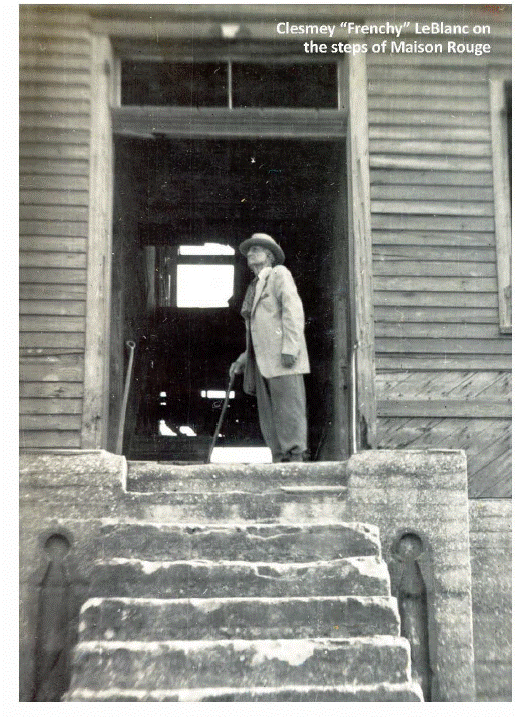
Nearly blind, he leased the land where the Maison Rouge ruins now stand, living there for seven years. At the time, the building’s wooden upper stories - though fragile - were still intact.
“He had a trailer on the lot, and he had another elderly man living with him,” Celina shared. Both men were in poor health and had limited incomes, relying on each other for daily support.
In a newspaper interview from that period, LeBlanc said of his roommate, “I have to feed him most of the time. I can’t eat when he has no food.”
It’s almost poetic: the two men, and the structure they occupied, were all weathered and dependent - bound together by circumstance and a lease that kept the building standing as long as they remained.
The only surviving photos of LeBlanc were taken by his daughter Alicia, posed on the steps of Maison Rouge. They were among the few family pictures to survive the floodwaters of Hurricane Ike.
By 1952, both of LeBlanc’s daughters were married and living in rented apartments on the island. Feeling it was long overdue for the family to reunite, LeBlanc hatched a new plan.
Newspapers interviewed the hermit about his latest scheme: he offered to trade the Selma for a house where his family could live together. He reasoned that the ship offered far more space and potential than a modest home.
But the concrete hulk wasn’t exactly a tempting investment - and more importantly, it was too late to bring together children he barely knew.
“He wanted a house for us to all live in,” Celina recalled with a laugh. “My sister and I couldn’t have lived together - we would have killed each other.”
Frenchy passed away two days before Christmas in 1958 at the age of 82. He is buried in an unmarked grave in the “Marine” section of Calvary Catholic Cemetery in Galveston.
“When his funeral announcement was in the paper, they used his proper first name of Clesmey, and no one knew who that was, so no one came,” Celina sadly noted. “They would have known who Frenchy was - but not Clesmey.”
The first time Celina stepped aboard the Selma, she was a grown woman. Soon after her father’s death, she, her sister, and brother-in-law visited their unusual inheritance with a mission in mind.
“It was really spooky. It was like Gilligan’s Island out there,” she recalled. “My sister didn’t want anyone on board the ship, and she got the bright idea to paint no trespassing signs on it.”
Their visit quickly turned into an adventure. “We got a boat and went out there. Instead of tying the boat to the back where it was low, my sister’s husband tied it to the front where it was high out of the water,” she remembered.
“While we were on the ship, our little boat floated away! My brother-in-law was out there waving a white handkerchief at everyone who passed, and they just smiled and waved back. I thought we were going to have to spend the night out there.”
“It was eerie and terrible,” she added. “The rebar was coming up and curling upward, and there were big holes in the deck. Finally, some man came by and got us back to shore. It was the only time I was on it - and one time was enough for me.”
Years later, Celina would ride the ferry and quietly observe passengers pointing toward the Selma, sharing stories and speculations. “I never said anything,” she said. “I just listened to all the stories about it and my father.”
The fisherman born in a small Louisiana town lives on in Galveston folklore as the Hermit of the Selma - a man who turned a forgotten ship into a home, a headline, and a legend.