Texian Navy Day is observed annually on the third Saturday of September, a day set aside to honor the courage and determination of the early Texas Navy - those who helped secure the Gulf of Mexico and defend the Republic’s independence at sea.
This year, Texian Navy Day falls on Saturday, September 20, with several commemorative events planned in Galveston to celebrate the rich and colorful legacy of Texas’s maritime defenders.
Two official Texas Navies served the Republic of Texas between 1835 and 1846. Though their fleets were modest and their service brief, their impact on Texas’s fight for independence and coastal protection was profound.
Galveston harbor served as the cradle of this fledgling naval force, which would soon challenge Mexican control of the Gulf and support the Texian Army with critical supplies and strategic disruption.
The first Texas Navy was formally established on November 25, 1835, when the General Council authorized the purchase of four schooners. This move was driven by the urgent need to protect the coastline and disrupt Mexican supply lines during the revolution.
The earliest naval actions were carried out by privateers - privately owned vessels commissioned by the Provisional Government of Texas to engage enemy ships and support supply efforts. These ships operated under letters of marque and reprisal, a legal framework that allowed them to seize enemy cargo and contribute to the war effort.
The Texas Navy began in earnest with the acquisition of four schooners in early 1836: the Liberty, Independence, Brutus, and Invincible. These vessels formed the backbone of the first Texas Navy, tasked with protecting the coastline and disrupting Mexican supply lines during the revolution.
Much-needed munitions and provisions were delivered to the Texian Army from captured Mexican ships, thanks to the Navy’s aggressive patrolling and raids.
Following Texas’s victory at San Jacinto on April 21, 1836, the Navy continued to blockade Mexican ports and harass enemy vessels until late August 1837, when the last of the original four ships was lost.
The Liberty was seized by creditors in New Orleans and sold in June 1836. The Independence, formerly the U.S. revenue cutter Ingham, was captured by Mexican forces off the coast of Brazoria (near modern-day Freeport) in April 1837, after a brief naval engagement.
The Invincible and Brutus were run aground and destroyed near Galveston Harbor on August 27, 1837, while fleeing two Mexican warships.
Despite their short service, these ships played a vital role in securing Texas’s independence and asserting its presence in the Gulf of Mexico.
After Sam Houston’s first presidential term ended, Mirabeau B. Lamar was elected and took office as the second President of the Republic of Texas on December 10, 1838. Unlike Houston, Lamar was a strong advocate for naval power and recognized the urgent need to rebuild the fleet following the loss of the first Texas Navy.
Encouraged by congressional support and facing a months-long threat of Mexican naval activity, Lamar threw his full backing behind the creation of a new fleet. With the acquisition and commissioning of the steamship Zavala on March 23, 1839, the second Texas Navy officially became operational.
Commodore Edwin W. Moore, a seasoned U.S. Navy officer with a reputation for bold leadership, was appointed to command the new fleet. Under his direction, Texas began assembling a formidable squadron.
Over the summer of 1839, Texas took delivery of the schooners San Jacinto, San Antonio, San Bernard, and Louisville. The brig Wharton was added in the fall.
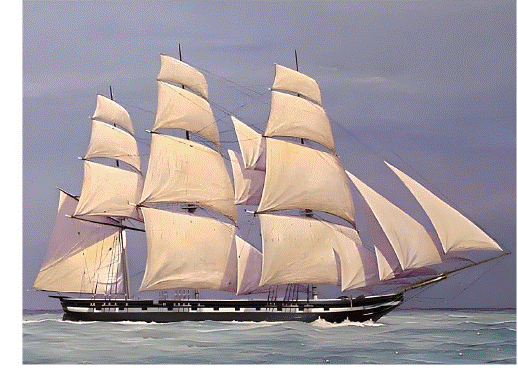
By 1840, the schooner Colorado (later renamed Archer) and the sloop-of-war Austin, which became Moore’s flagship, also arrived in Galveston
That summer, President Lamar ordered Commodore Moore and a squadron of ships to the Yucatán coast to assess the political climate in the rebellious Mexican state. Yucatán was in open revolt against Mexico’s centralist government, and Texas sought to form a temporary military alliance to keep Mexican forces occupied and away from its own borders.
Seeking an ally in Campeche, Lamar hoped to divert Mexico’s attention inward, allowing Texas to strengthen its position without direct confrontation. The mission proved diplomatically successful, and the Texas Navy played a key role in supporting Yucatán’s federalist rebels.
However, the campaign came at a steep cost. The Zavala was severely damaged during a storm near the mouth of the San Juan Bautista River (modern-day Grijalva River historically referred to as the Tabasco River).
The San Jacinto ran aground and was wrecked near the Arcas Islands, and the crews of the Austin and San Bernard suffered from scurvy, yellow fever, and influenza, resulting in the deaths of many officers and sailors, though exact numbers vary across sources.
Despite its early promise, the second Texas Navy was short-lived. The high cost of acquiring ships, maintaining the fleet, and operating the Galveston navy yard placed a heavy strain on the Republic’s already fragile finances. As Texas’s debt mounted, support for the Navy waned, and its future became increasingly uncertain.
After Sam Houston was re-elected President of the Republic of Texas in December 1841, he resumed his cautious stance toward naval expenditures. Houston withheld appropriations for the second Texas Navy and vetoed a resolution that would have granted land bounties to veterans of the first Texas Navy - despite prior promises and legislative support.
When the fleet returned to Galveston, it was underfunded, underfed, and unpaid. A $20,000 payroll authorized by Congress was denied by Houston, leaving sailors and officers without compensation. In protest, nearly all commissioned officers resigned on May 7, 1842, citing lack of pay and support.
Despite Houston’s objections, the Texas Congress appropriated additional funds in July 1842 to cover back pay and provide essential supplies to keep the remaining ships operational. This brief reprieve allowed the Navy to continue limited service, though its future remained uncertain amid mounting political and financial pressures.
In early 1843, with the Austin and Wharton docked in New Orleans for repairs, Commodore Edwin W. Moore entered into an agreement with the acting governor of Yucatán to help break a Mexican naval blockade of Campeche and drive enemy warships from the region.
In exchange for Texas’s naval support, the Yucatán government agreed to pay $8,000 in silver upfront and a monthly stipend of the same amount to cover the fleet’s upkeep. This infusion of funds allowed Moore to restore his ships and crew to fighting strength and helped divert Mexican naval pressure away from the Texas coast.
When news of the alliance reached President Sam Houston, he was outraged. Viewing Moore’s actions as unauthorized and provocative, Houston issued an order suspending Moore’s command and called for his arrest upon return to Texas.
He also declared the Texas Navy to be acting as pirates and requested foreign governments to detain the ships if encountered.
 Moore was ordered to return to Galveston with the fleet intact. Naval Commissioner James Morgan delivered Houston’s orders and joined Moore aboard ship on April 19, 1843, as the fleet prepared to sail back to Texas.
While anchored near New Orleans, the Texas squadron received word from the schooner Rosario that Mexican forces were massing on the Yucatán Peninsula - not for an invasion of Texas, but to reinforce the blockade of Campeche and suppress the Yucatán rebellion.
Naval Commissioner Morgan urged Commodore Moore to proceed to Campeche “to save the Republic.” The squadron headed south to assess the threat and support their Yucatecan allies.
On April 30, 1843, the Austin, commanded by Moore, and the Wharton, commanded by Captain John T. K. Lothrop, engaged the Mexican steam warships Guadalupe and Montezuma (also referred to as Moctezuma) - two of the most advanced iron-hulled steamships of their time - along with several smaller gunboats.
The battle helped lift the blockade and diverted Mexican naval pressure from both Yucatán and Texas.
On May 16, the Texas ships, joined by a Yucatán squadron commanded by former Texas Navy Captain James D. Boylan, re-engaged the Mexican fleet in a fierce cannonade. Despite being outgunned, the Austin and Wharton inflicted serious damage on the Guadalupe and Montezuma, marking one of the few historical instances where sail-powered ships successfully battled steam-powered iron-hulls.
The Austin sustained multiple direct hits and suffered seven killed and 24 wounded but was repaired and made seaworthy within days. The Wharton suffered two killed and four wounded, including damage from an onboard gun explosion.
The mission, though unauthorized, was a tactical and symbolic success. The fleet returned to Galveston on July 14, 1843 to a hero’s welcome, greeted by cheering crowds at the wharf.
Even though the City of Galveston welcomed the Texas Navy home with open arms, President Sam Houston was furious, viewing the Yucatán campaign as a blatant act of defiance by Commodore Moore and his officers.
Within days, Houston issued a dishonorable discharge for Moore, accusing him of disobedience, piracy, and murder - the latter charge stemming from Moore’s role in the execution of mutineers aboard the San Antonio. Treason was not among the formal charges, though it was implied in Houston’s rhetoric.
Moore demanded a trial to clear his name, and after a lengthy court-martial in 1844, he was acquitted of all major charges and found guilty only on four minor counts of disobedience.
Congress did not reinstate Moore to active command, but it did clear his record and recognize his service, effectively ending the dispute.
In July 1843, Commander John T. K. Lothrop was also dishonorably discharged, though no formal trial was held at the time. He later appeared before a military court in May 1844, where evidence revealed no cause for his dismissal, and the discharge letter was never officially issued.
Tragically, Lothrop died of yellow fever on August 14, 1844, just weeks after his name was cleared.
The Texas Navy never sailed again. By the mid-1840s, the remaining ships were in disrepair, and most of the crews had resigned in protest after years without pay or support.
The cost of sustaining the fleet had become more than the cash-strapped Republic could bear. Yet without the Navy’s early efforts, Texas may never have secured its independence from Mexico.
A commemorative third Texas Navy was established on April 21, 1958, by Governor Price Daniel, who proclaimed its reactivation as a patriotic organization dedicated to preserving naval history. The date was chosen to coincide with the anniversary of the Battle of San Jacinto.
Now known as the Texas Navy Association, the organization is based in Galveston and is devoted to honoring the legacy of the first and second Texas Navies through education, historical preservation, and ceremonial recognition. More information can be found at texasnavy.com.