June arrives on Galveston Island not with a whisper, but with a thick, salt-laced exhale. The light turns brighter, harder somehow, bouncing off water and pavement alike, and the garden - if it has been tended well through spring - begins to reveal what it can truly endure. This is not a gentle month. It is a proving ground.
By now, whatever you planted in March and April has declared itself. The soft optimism of spring gives way to something more honest.
Zinnias, if you chose them, are likely already holding their ground - bright, unapologetic, and seemingly immune to both heat and humidity. Pentas draw in butterflies even in the stillest air, their clusters of star-shaped blooms unfazed by the long, damp nights.
And vinca - often overlooked - earns its place this time of year, thriving where others falter, its glossy leaves shrugging off both salt spray and neglect.
 There is a particular satisfaction in walking the garden in June and recognizing resilience. Not perfection - never that - but persistence. The island teaches that quickly.
Water, for instance, becomes less about routine and more about strategy. Early morning is no longer just a preference; it is a necessity.
There is a particular satisfaction in walking the garden in June and recognizing resilience. Not perfection - never that - but persistence. The island teaches that quickly.
Water, for instance, becomes less about routine and more about strategy. Early morning is no longer just a preference; it is a necessity.
By midday, the soil warms to a point where water applied too late becomes more burden than benefit, evaporating before it can reach the roots.
Deep, infrequent watering encourages plants to reach downward, anchoring themselves against both drought and wind. Shallow watering, like shallow roots, rarely survives what summer has in store.
And the wind - always present, always shaping - carries more than just movement. It brings salt, subtle but constant, settling onto leaves and into soil.
Some plants accept this quietly. Others protest in yellowed edges and stunted growth. The difference is not always in how much you care for the garden, but in how well you understand where you are gardening.
This is why the June garden becomes, in many ways, a study in acceptance. Not every plant belongs here, no matter how beautiful it looked in a catalog or how well it thrived somewhere inland.
The island rewards those who choose wisely: native grasses that bend instead of break, perennials that have made peace with heat, shrubs that do not demand coddling.
Even herbs reveal their preferences now. Basil, if pinched regularly, will continue its fragrant insistence on growing. But let it go too long without attention, and it bolts quickly, rushing toward seed as if trying to outrun the heat.
Rosemary, on the other hand, stands firm - woody, aromatic, and nearly indifferent to the conditions that challenge everything around it.
There is work to be done, of course, but it shifts in tone. June is not about planting expansively; it is about maintaining thoughtfully.
Deadheading becomes less about aesthetics and more about energy - guiding the plant to keep producing rather than surrendering to exhaustion. Mulch, applied generously, becomes a quiet ally, holding moisture in the soil and offering a buffer against the relentless sun.
And then there is the watching. June asks you to pay attention. Not just to what is blooming, but to what is struggling.
Leaves that curl too tightly. Color that fades too quickly. Soil that dries faster in one corner than another.
These are not failures; they are information. The garden speaks more clearly now than it did in spring, if you are willing to listen.
By late afternoon, when the light softens and the heat loosens its grip just slightly, the garden settles into itself. There is a stillness then, broken only by the low hum of insects and the occasional movement of leaves catching what little breeze remains.
It is in these moments that the June garden feels less like something you control and more like something you are allowed to witness.
On Galveston Island, that distinction matters. Because this garden - this place carved out of sand, salt, wind, and will - was never meant to be perfect. It was meant to survive.
And with a bit of understanding, and a willingness to work with rather than against it, it can do something more. It can thrive, in its own stubborn, sunlit way.
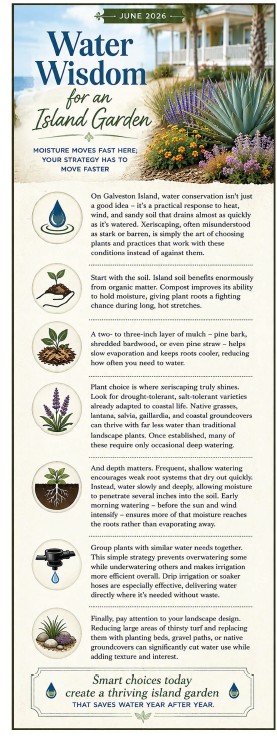
Water Wisdom for an Island Garden
Moisture moves fast here; your strategy has to move faster
On Galveston Island, water conservation isn’t just a good idea - it’s a practical response to heat, wind, and sandy soil that drains almost as quickly as it’s watered. Xeriscaping, often misunderstood as stark or barren, is simply the art of choosing plants and practices that work with these conditions instead of against them.
Start with the soil. Island soil benefits enormously from organic matter. Compost improves its ability to hold moisture, giving plant roots a fighting chance during long, hot stretches.
A two- to three-inch layer of mulch - pine bark, shredded hardwood, or even pine straw - helps slow evaporation and keeps roots cooler, reducing how often you need to water.
Plant choice is where xeriscaping truly shines. Look for drought-tolerant, salt-tolerant varieties already adapted to coastal life.
Native grasses, lantana, salvia, gaillardia, and coastal groundcovers can thrive with far less water than traditional landscape plants. Once established, many of these require only occasional deep watering.
And depth matters. Frequent, shallow watering encourages weak root systems that dry out quickly.
Instead, water slowly and deeply, allowing moisture to penetrate several inches into the soil. Early morning watering - before the sun and wind intensify - ensures more of that moisture reaches the roots rather than evaporating away.
Group plants with similar water needs together. This simple strategy prevents overwatering some while underwatering others and makes irrigation more efficient overall. Drip irrigation or soaker hoses are especially effective, delivering water directly where it’s needed without waste.
Finally, pay attention to your landscape design. Reducing large areas of thirsty turf and replacing them with planting beds, gravel paths, or native groundcovers can significantly cut water use while adding texture and interest.