The trellis arrives looking like a promise. Pale cedar, neatly latticed, offering just enough enclosure to suggest privacy without shutting anything out. It’s the kind of piece that makes you think - briefly - that you can recreate the photograph on the box: cascading roses, lush and romantic, climbing as if they’ve always belonged there.
You can’t. Not here. Not in Galveston. That isn’t a failure of the gardener; it’s a misunderstanding of the place.
On this island, the rules shift. The air carries salt whether you see it or not. The heat doesn’t ease in - it arrives, settles, and stays.
Containers, especially shallow ones, behave more like temporary landscapes than permanent beds. They heat quickly, dry out faster, and demand plants willing to live a little more urgently.
I learned that the hard way. Years ago, I tried to coax a climbing rose into a container much like that trellis promised. It leafed out, even bloomed once, and for a moment I thought I had outsmarted the climate.
By July, it was finished. The roots simply didn’t have the room to do what roses need to do, and no amount of attention could change that.
May, though, is forgiving. It gives you a window. The light is generous, the evenings are still manageable, and there’s just enough time to plant something that will take hold before the real heat begins to press in.
This is when you stop trying to force the garden you saw somewhere else and start building one that actually belongs here. The trick isn’t to go bigger. It’s to go lighter.
Heavy, woody climbers - roses, jasmine, even some of the more ambitious perennials - want depth. They want room to anchor, to store water, to settle in for years.
A six-inch planter can’t offer any of that. What it does offer is immediacy. And that’s where annual vines come in.
Black-eyed Susan vine is one I return to again and again. It doesn’t argue with the conditions. It climbs quickly, threads itself through a trellis with very little direction, and blooms steadily through the kind of heat that sends other plants into retreat.
The colors are soft - yellows, apricots, the occasional pale cream - and they hold their own in the glare of a coastal afternoon. It isn’t a rose. But it doesn’t need to be.
What matters just as much is what happens at the base. This is where most container trellises fail.
The vine climbs, the top fills in, and below that - nothing. A bare box, dry soil, the whole thing looking slightly unfinished.
The fix is simple, but it’s often overlooked. You plant for spill.
Nasturtiums do this better than almost anything else. They don’t just sit in the container; they move. Leaves and blooms drift over the edge, softening the line between planter and space.
In a place like Galveston, where hard surfaces and bright light can feel relentless, that softness matters. It’s what makes the whole arrangement feel intentional rather than improvised.
I’ve also found they forgive you a little. Miss a watering and they’ll let you know - but they usually recover. In a shallow planter in June, that’s no small advantage.
What you’re really doing, whether you think of it this way or not, is layering. Something to climb. Something to spill.
Occasionally something to sit between and hold it all together. A small fern, a bit of coleus - nothing complicated, just enough to give the eye a place to rest.
By the time the vines begin to take hold, the change is noticeable. The trellis stops looking like an object and starts behaving like part of the space.
Light filters differently. The air feels a degree cooler, even if it isn’t. You begin to linger a little longer without quite realizing why.
There’s also a practicality to all of this that shouldn’t be ignored. Gardening on the coast has a way of teaching you where to invest your energy.
Annual vines make sense here. They grow fast, give you what you want within a single season, and don’t ask you to carry them through a hurricane. That matters more than people admit.
Watering becomes routine, not optional. In six inches of soil, there is no reserve. What’s there in the morning may not be there by late afternoon.
You learn to check without thinking - on your way out, on your way back in. It becomes part of the day.
Fertilizer helps, but it doesn’t need to be heavy-handed. A light feed every couple of weeks is enough.
Push too hard and you get growth the plant can’t sustain in the heat. It’s better to let things move at a pace the environment will support.
And then, inevitably, there’s the comparison - to the photograph, to the idea you started with. That’s the part you have to let go of.
What you end up with, if you do this right, is not a copy. It’s something more specific.
A trellis that fills in quickly, yes - but also one that reflects the conditions it lives in. The light, the air, the limits and the possibilities of a place that doesn’t tolerate pretense for long.
By early summer, it’s no longer something you assembled. It’s something that has settled in.
The vines have found their paths. The edges have softened. The whole thing feels less like a project and more like a small, working part of the space.
And that, in Galveston, is usually the point.
COASTAL CLIMBERS
Gardening on Galveston Island means choosing plants that can handle heat, humidity, salt air, and the occasional blast of wind - all while often growing in less-than-ideal soil. When it comes to climbers, success depends on selecting varieties naturally suited to USDA Zone 9a/9b and tolerant of coastal exposure.
For shallow planters or challenging sites, lighter, faster-growing vines consistently outperform heavy, woody climbers. The selections below offer beauty, resilience, and a proven ability to thrive along the Gulf Coast.
 Black eyed Susan Vine
A standout for containers and trellises, this vine thrives in heat and blooms steadily through long Gulf Coast summers. Its delicate-looking flowers belie a tough constitution, and it handles humidity with ease. Ideal for seasonal coverage where you want quick results and a soft, romantic look.
 Carolina Jessamine
A native favorite, this evergreen climber produces fragrant yellow blooms in late winter and early spring. Once established, it tolerates heat and occasional salt exposure, making it a reliable choice for more permanent plantings in the region.
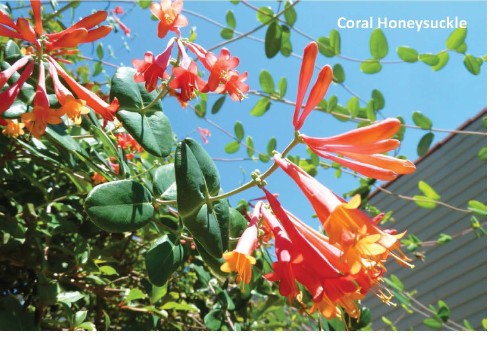
Coral Honeysuckle
Another native that performs beautifully along the coast, this vine offers tubular red or coral flowers that attract hummingbirds. It is more restrained than invasive honeysuckles and adapts well to the Gulf’s climate, though it prefers a bit more root depth than very shallow containers can provide.
Confederate Jasmine
Loved for its intensely fragrant white blooms, this evergreen vine performs beautifully in Galveston’s climate. It tolerates heat and humidity well but benefits from deeper soil and some protection from direct salt spray. Best used where roots have room to establish.
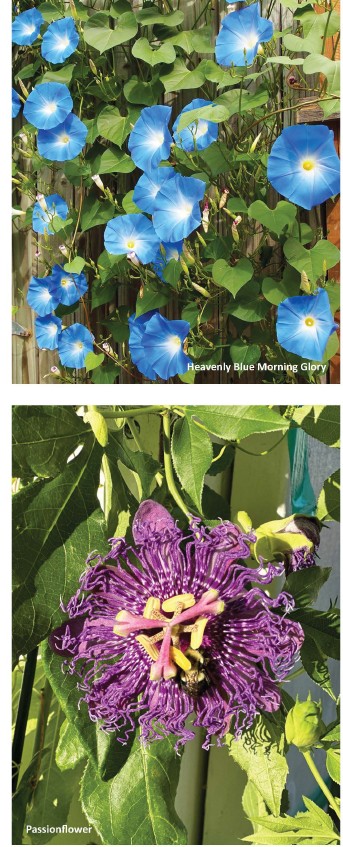
Passionflower
Exotic in appearance but surprisingly tough, passionflower thrives in warm climates and handles the Gulf’s conditions once established. Its intricate blooms and vigorous growth make it a striking choice, though it can spread enthusiastically in the right setting.
Morning Glory
For fast seasonal coverage, few vines perform like morning glory. It germinates quickly in warm soil and climbs rapidly, producing abundant blooms. Particularly useful for filling trellises in a single season, especially in containers or shallow beds.
In Galveston, the most successful approach is often a mix of permanent structure and seasonal softness - a reliable perennial vine where space allows, paired with lighter annual climbers that bring immediate fullness and color.
With the right choices, even the most exposed patio or compact planter can become a lush, living screen that works with the coast rather than against it.