Discovered in Japan in the 1700s, the sago palm can be seen everywhere on Galveston Island and is considered one of the most popular of landscape palms. It is not, however, a palm tree at all.
It is a cycad as its scientific name Cycas revoluta indicates, although it has some of the characteristics of palm trees and lends itself easily to the tropical look desired by many islanders. This plant is one of the easiest to grow in beds, in containers or as a single focal point in any landscape plan.
The sago palm is known for its durability and its indestructibility is legendary. Having not only out-lived the dinosaurs, it can survive adverse conditions of nature as well as the neglectful gardener.
Sago palms have three- to four foot dark green leaves on sturdy trunks that may extend upwards six to ten feet if planted in full sun. New leaves emerge at one time in a circular pattern with feathery and fern-like appearance and they are quite delicate. Eventually the leaves will stiffen and become bristly.
A little housekeeping in the way of trimming may be necessary annually, removing any yellowing or brown leaves from the lower trunk to maintain a healthy looking specimen. If you notice the yellowing of leaves near the crown, this may be the result of the application of too much fertilizer or over watering.
The male and female of the species have quite distinctive characteristics and can be easily identified. The male plant produces a “pineapple-shaped” cone that may grow to two feet tall while the female generates a large golden round cone with a packed seed-head.
If pollination by the birds and the bees is successful, these seeds mature from September to October. Propagation may be accomplished by using these seeds. This can be a very rewarding project although time consuming, and probably hit or miss since you must use seeds that have been pollinated by the above mentioned birds and bees.
Another method to successfully achieve propagation is with the use of offsets or pups that grow at the base or along the sides of existing sago palms. Removing and planting the pups may be a more reliable source of a continued supply of new plants.
They can be popped off the parent trunk with your garden spade in early spring, late fall, or winter. Once off, remove any leaves or roots and set the pups aside to dry.
After a few days, you may plant these new clippings in a pot of well-draining soil with half the ball or trunk portion below soil level, water thoroughly, and place in a shady area. Allow the soil to become nearly dry before additional watering. The cuttings will soon grow new roots and leaves.
Apply a light fertilizer after a few months when the leaves begin to appear. Re-pot after the plants are well established with their new root systems.
The sago palm is cold tolerant to 20 degrees and is extremely hardy with few disease or pest problems. Scale or mealy bug infestation may be treated with insecticidal soaps or with a scalicide.
A lethal cycad scale outbreak was once reported in Florida with the introduction of an armored scale from Southeast Asia. The affected cycads were nearly completely covered with a white crust that gave the appearance of a layer of fine snow.
The scales sucked all the juices out of the leaves and the cycads died within a few weeks. Therefore, it is important to treat any insect problem without delay to prevent a widespread infestation of neighboring plants and gardens.
Sago palms prefer full sun but will develop and mature in some shade; they are tolerant of most soils as long as there is good drainage. They are easily cared for needing very little in the way of constant care…a little fertilizer once a year, a little trimming of yellowing or brown leaves and they are good to go.
The Bonsai Sago
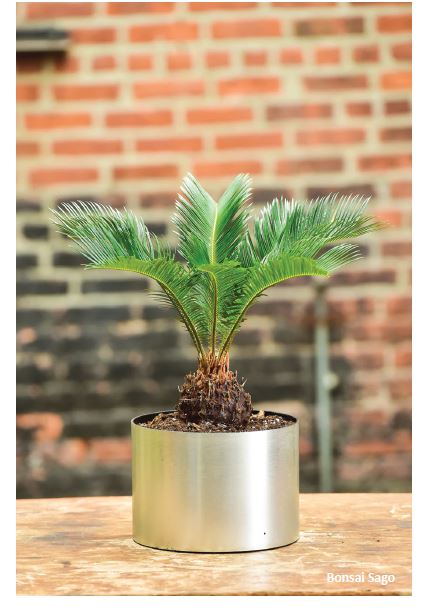 As noted above, sago palms are known for their very slow growth, so little pruning is necessary. When grown as potted indoor specimens, they may add only one set of new leaves in a year or even two years while remaining nearly the same size during that time, which is one reason why they are excellent when grown as bonsai.
You can prune your bonsai sago at any time by removing any yellow or brown leaves. This is a true tropical tree and thrives in heat and humidity; they cannot tolerate dry conditions.
Water the bonsai sago tree generously in summer and keep the soil moist in winter. Spraying water on the foliage will increase the humid condition necessary around the tree.
In order to miniaturize, the leaves and growth pattern of the bonsai, it is recommended that the roots be restricted in a bonsai container. Do not overlook the container in which you display your bonsai. These pots play an important role in creating the “bonsai effect” by establishing a completed cycle of harmony.
Customarily, a bonsai pot should complement the masculine or feminine features of the plant itself—thick trunks, heavy branches, and sharp angles would be characteristics of a male form while rounded silhouettes, smooth or light-colored bark and thin trunks are more ladylike in appearance.
For a masculine structure choose pots that are square, rectangular or hexagonal with straight lines in earth tones or dark shades. Pots with a feminine impression are oval, curved, or round with decorative designs in soft hues of cream and pastel.
It is important to keep in mind the poisonous qualities of the Sago Palm. All parts of this plant are poisonous, but the seeds contain the highest level of toxins. Family dogs are at most risk of ingestion of the seeds. The sago is listed as one of the top ten most poisonous plants to pets by the ASPCA. If any quantity of this plant has been ingested, prompt and aggressive treatment is recommended as the toxins may cause internal damage and death.