Derived from the Anglo-Saxon word “fearn” meaning “wing,” ferns are sometimes called “wings of comfort.” These typically flowerless plants have feathery fronds divided into leaflets where a vascular system transports water and nutrients while reproduction is sustained through the release of spores from the bottom sides of the fronds themselves. Ferns provide microhabitats, shade, and shelter as well as sources of sustenance for birds, animals, and other small living creatures.
Some ferns can live up to one hundred years depending on the species. Ferns are from a very ancient family of plants with symbolic significance, ceremonial as well as spiritual importance has been associated with ferns throughout history. They are considered icons of luck, riches, protection and rainmaking.
In folklore, they are said to symbolize eternal youth, and in the language of flowers, magic, fascination, sincerity, and humility. To the indigenous tribes of New Zealand, ferns represent new life and a new beginning while to the Japanese hope for future generations.
Awarded with the Royal Horticulture Society’s Award of Garden Merit in 1993, Staghorns (P. bifurcatum) or “funky” ferns include several species of epiphytic (air plant) vegetation native to Africa, Australia, and Asia that resemble the antlers of male deer or elk when touting thinner or narrower fronds.
These ornamental plants are quite easy to cultivate in mild climates zone nine and up. They are hardy down to temperatures of 40 degrees, and when temperatures fall below that, move to a warmer location or indoors if possible.
The staghorn fern has become naturalized in Florida and Hawaii and flourishes seasonally out of doors in temperate climates. They can be a striking addition or ornament when attached to a fence or wall display with other forms of epiphytes.
 Essential elements to this tropical plant life are adequate air circulation, indirect light, warm dependable temperatures, humidity, and regular moisture. Staghorn ferns absorb water through their roots, fronds, and potting or attaching mediums, but they will rot if overwatered. Older and established plants can withstand longer periods without water, naturally needing more water in summer months or direct sunlight and less moisture in cooler weather.
In nature, Staghorn ferns thrive attached to trees, but they can be cultivated by mounting on wooden boards, wedges of driftwood, or chunks of bark to better exhibit their unique characteristics and distinguishing charm. Secure the plant to your support with fishing line, wire, plastic mesh, or nylon hose, wrapping it around and firmly through the brown shield-shaped fronds to hold the fern in place. Avoid wrapping the soft green fronds as that can cause damage.
Adding some sphagnum or peat moss between the backing and the green fronds is helpful as well. The growth of new fronds will conceal the fastening material in place as they grow over it.
Small staghorn ferns can be grown in wire containers or well-draining receptacles when supplied with an appropriate amount of growing medium. Fertilize monthly with a balanced, diluted liquid fertilizer placed in the growing medium or sprayed on with a spray bottle.
Staghorn ferns can grow up to three feet across and produce two types of fronds, Sterile (non-reproductive) fronds are rounded and overlapping and green in color, becoming papery tan with age that collects nutrients.
Fertile (reproductive) forked “leaves” grow from the base up to 18 inches long. They are brighter green with brown tips (plantlets or pups) that can be removed to grow as a new plant.
Another interesting funky and fancy fern is the Bird’s Nest fern, a perennial plant native to Asia, Australia, and Africa. Bird’s Nest ferns are a popular houseplant as they are not toxic to humans or pets and are thought to be good-luck symbols especially when tucked among the branches of the family Christmas tree to bring prosperity to the home.
These ferns thrive in warm, humid climates in filtered sunlight and shade; direct sunlight can burn the delicate leaves. They will tolerate temperatures to 50 degrees for short periods of time, but prolonged exposure to cold will damage or demolish the foliage quickly.
They thrive in pots of loose, rich soil that has been fortified with organic matter that provides adequate drainage. They prefer moist soil but will not tolerate soggy soil, so avoid watering the center of the plant to prevent rot and mold. Also avoid wetting the fronds themselves.
A slow, constant growth rate of erect, spoon-shaped, bright-green, graceful and extremely fragile fronds up to five feet long will rise from the central rosette that resembles a bird’s nest. Repot in a larger clay pot only when the fern becomes so large that the roots need more space and the plant has become unstable.
The fronds may turn brown as they die and are replaced with the new growth. Brown foliage may also be a result of too much moisture or drafts; yellowing leaves can be triggered by too much sun or too much fertilizer. Fertilize monthly into the soil from April through September with a balanced liquid formula that has been diluted by half.
Few pests bother the Bird’s Nest fern. If the occasional visit from scale occurs, treat with a natural insecticidal soap. Do not apply chemicals.
Types of Bird’s Nest Ferns
Crispy Wave– Sword-shaped, ruffled leaves
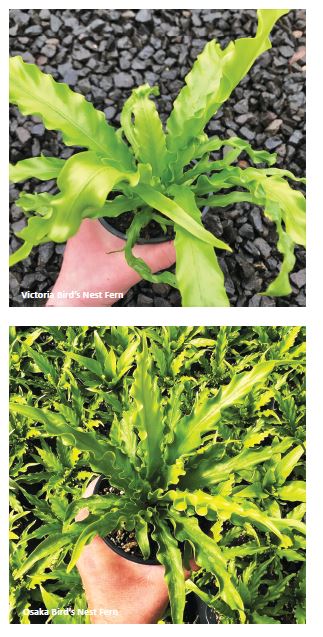
Osaka– Narrow, strap-like leaves with rippled edges
Antiquum– Wavy leaf margins
Victoria– Long, wavy, tongue-shaped fronds