In a neighborhood steeped in Victorian charm, the house at 902 16th Street stands as a quiet tribute to Galveston’s resilience in the wake of the 1900 Storm.
In March 1907, a brief notice in the Galveston Daily News announced that Mr. and Mrs. Morris Stern had purchased the corner lots at Sealy and 16th Street - then known as “Corbett’s Corner.” By summer, contractor James J. Quilter had begun construction on a home that blended modern concrete-block techniques with old-world elegance.
The residence was built for German-born merchant Morris Stern (1864-1944), his wife Ella Rosalind Herman (1879-1946), and their son, Morris Jr. (1903-1980).
Stern’s company, Ullman, Stern & Krausse, operated a network of wholesale grocery warehouses across Texas, purchasing goods in bulk for statewide distribution. The scale of their operation was no small matter.
In March 1907 - the same month Stern purchased the lots for his new home - a local newspaper featured an advertorial highlighting the company’s purchase of 15¼ tons of Good Luck Baking Powder, said to be enough to leaven 15 million biscuits. The shipment, delivered by railcar, underscored the reach and buying power of Stern’s growing enterprise.
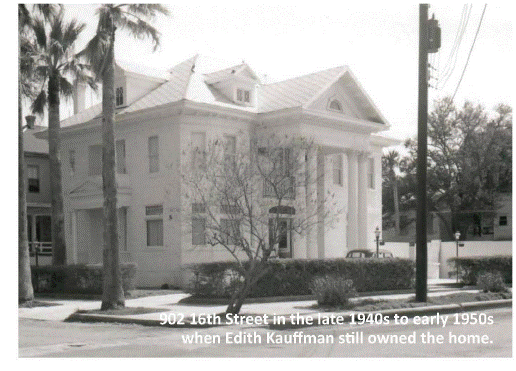
Stern’s stately Neo-Classical home became a symbol of status and Galveston’s post-storm revival. Beyond the cast-iron gate - still standing today - visitors were greeted by a striking façade: a white pediment crowning the entrance, flanked by double Corinthian columns with intricately carved capitals.
 Inside, a grand oak reception hall featured paneled walls, an elaborately carved switchback staircase, and matching wood floors. At its base, a cozy inglenook framed the home’s sole fireplace, with built-in bench seats likely hosting a century’s worth of quiet conversations.
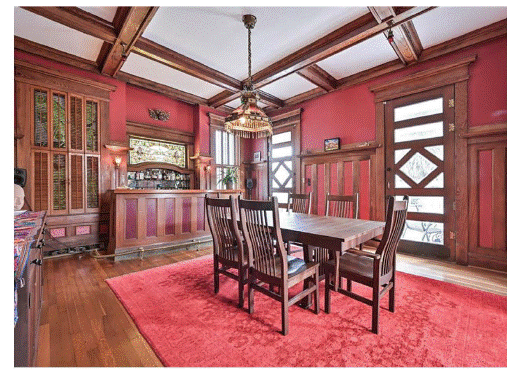
Pocket doors opened to a formal parlor and den on the right, and a dining room on the left, where jeweled stained-glass windows scattered prismatic light across the floors and walls.
Modern for its time, the home was powered by both gas and electricity, equipped with steam heat, ten closets, two pantries, nine rooms, one and a half bathrooms, and four porches and balconies.
Behind the main house, a two-story, 16-by-24-foot garage accommodated Stern’s automobile on the ground floor, with two servants’ rooms above. The finished third floor of the main house, originally attic space, was soon converted into additional quarters for household staff.
The Stern home was more than a symbol of success - it was a lively setting for family life and elegant entertaining. In November 1908, Morris and Ella welcomed a daughter, Jeanette Ann “Jane” (1908-1987). Just weeks later, Ella placed a newspaper ad seeking a nanny to “take charge” of her young son, a glimpse into the demands of managing a growing household.
Beyond her domestic responsibilities, Ella remained deeply engaged in civic life. She was an active member of the Council of Jewish Women and the Women’s Health Protective Association, which championed public health and city beautification in the years following the 1900 Storm.
She also chaired fundraising events for Jewish charities and frequently hosted organizational meetings and social gatherings in the family’s gracious home.
One such event - a Japanese-themed bridge luncheon held on December 1, 1909 - welcomed 50 guests. The décor featured shades of yellow and mahogany, with tally cards adorned in Japanese prints.
Guests received Japanese fans during play, and prizes included a brass gong, an inscribed picture frame, a tray of Japanese silk mounted on glass and ebony, and a brass fern bowl. Each attendee took home a gold teacup painted adorned with figurine paintings.
 By 1910, the household included two live-in staff members: Elise White, a cook from Louisiana, and Hermine Hense, a French immigrant who served as the family’s housemaid.
As president of the Galveston Commercial Association, Morris Stern championed the unification of Texas’s commercial, industrial, and agricultural interests. He also played a key role in restoring Galveston’s reputation and rebuilding its business infrastructure in the years following the 1900 Storm.
In August 1915, while vacationing with his family in Estes Park, Colorado, Stern received word of another devastating hurricane striking Galveston. He immediately contacted city leaders to obtain accurate reports of the damage and losses.
Armed with firsthand information, Stern publicly refuted the exaggerated accounts circulating in Colorado newspapers - a critical move that helped calm investors and restore confidence in Galveston’s economy.
That November, Ullman, Stern & Krausse expanded their reach by acquiring a major distribution operation in San Antonio, prompting the family’s relocation to the Alamo City.
Years later, Morris Stern Jr. returned to Galveston and opened The Galveston Store of Good Housekeeping Inc. at 517 22nd Street, offering home furnishings and household gifts to a new generation of island residents.
In February 1918, Abraham “Abe” Levy Kauffman (1873-1919), a French-born businessman, and his wife Edith Salome Levy (1885-1967) purchased the Stern home for $10,000. They made a few alterations before moving in with their three children: Bernard Levy (1908-1978), Marjorie Rose (1911-1970), and Etta Mae “Sugar” (1913-2003).
Kauffman had moved to Galveston as a child with his parents and later became a partner in his father’s thriving business, Kauffman, Meyers & Co., which specialized in handmade furniture, carpets, stoves, and household goods. The company’s storefront at 2410 Market - now a parking lot across from the Buckshot Saloon - was once a bustling hub of island commerce.
Tragically, Abe Kauffman would enjoy the family’s new home for less than a year. He died in January 1919 following a three-week illness, leaving Edith to manage the household with the help of live-in cook Mary Golbert and nanny Louise Wentzel.
The 1920 census records show the family still residing in the home, now joined by husband-and-wife servants Henry and Mary Jabert, likely living in the servants’ quarters. Two additional staff members - cook Clara Wuest, age 24, and maid Milda Bernhard, age 31 - occupied the finished third floor.
Edith remained deeply engaged in Galveston’s Jewish community throughout her life. She served as vice president of the Temple Society of Temple B’nai Israel - just six blocks from her home - and chaired the local chapter of the Council of Jewish Women.
A gifted pianist, she frequently performed at social and charitable events, adding a cultural flourish to her civic involvement.
In 1937, her daughter Marjorie married Dr. Clarence Agress. Two years later, Edith’s eldest son, Bernard, had assumed his late father’s role in the family business by the time he married Celia Marie Gens in October 1939. The newlyweds lived with Edith in the family home for about a year and a half before purchasing their own residence in 1941.
When Bernard and Celia moved out, Edith’s youngest daughter, Sugar - who had married Herbert Garonzik in June 1939 - moved in. By 1950, the house was home to Edith, Sugar, Herbert, and their two young sons, Herbert Jr. and Philip.
In 1956, at age 71, Edith Kauffman sold her beloved home to LeRoy Applegate Jr. and his wife, Evelyn Mae Edwards, for $16,000. A World War II veteran who had served in the Merchant Marines, Applegate was working for Union Carbide at the time of the purchase.
 Six years later, the Applegates sold the property to V. E. Liles, who invested $22,500 in a substantial remodel in 1962. Just a year after the renovation, Liles sold the home to James Robert “Bob” Neal Jr. (1921-2006).
Neal, a World War II aircraft recognition instructor, was the grandson of John W. Neal, co-founder of Cheek-Neal Coffee - the company that would become Maxwell House. His wealth and charisma earned him a place among the era’s most eligible bachelors, listed alongside Howard Hughes, Marlon Brando, and King Baudouin of Belgium.
After the war, Neal lived in Palm Springs, Malibu, and Beverly Hills, where he befriended members of the Rat Pack, including Frank Sinatra, Sammy Davis Jr., and Peter Lawford. He served as best man at Lawford’s 1954 wedding to Patricia Kennedy, sister of future President John F. Kennedy and Senator Robert Kennedy.
During Neal’s ownership, the Galveston home gained a reputation as the “Rat Pack Party House,” hosting glamorous gatherings that drew entertainers and members of the Kennedy family to the island.
Neal leased the home from 1965 to 1966 before listing it for sale that September. The advertisement described four bedrooms and two and a half baths.
In the late 1980s, the house made a brief appearance on the silver screen as a filming location for the movie Keaton’s Cop.
Over the decades, the property passed through several owners before being purchased in 2019 by Dr. Michael P. Sheetz and Dr. Linda J. Kenney, both esteemed professors at UTMB. Dr. Sheetz has since passed away.
Today, the 4,484-square-foot, five-bedroom residence is listed for $1,350,000 - awaiting its next chapter in Galveston’s living history.