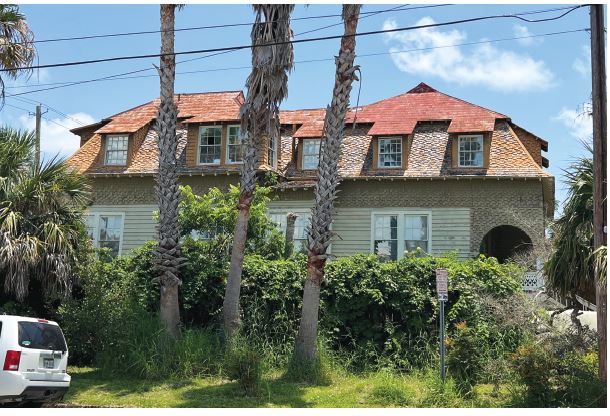
At 928 Church Street, mostly hidden from view by an overgrowth of shrubbery, vines, and a variety of palms, lies a home with a unique connection to a man regarded by many as the greatest painter of the nineteenth century: Winslow Homer (1836-1910). The house was owned by his brother, and he visited and possibly worked there several times.
Arthur Benson Homer (1841-1916) came to Galveston in 1874 and worked as a cotton buyer on The Strand for commission merchant George Wigg and Company. Within two years, he had married Alice Martha Patch (1848-1904) and welcomed the first of their two sons, Arthur Patch Homer (1876-1940) and Charles Lowell Homer (1881-1955).
The couple purchased a lot and a half on the northeast corner of 10th and Church streets on June 9, 1877 to build a home of their own. The property had previously been used as a nursery to propagate plum and orange trees, and Homer quickly worked to sell the specimens for $5 each to clear room for the home.
The interestingly gabled, mansard-style slate roof of the three-story house was more reminiscent of Homer’s east coast birthplace than the Texas coast, but was refreshingly charming amid the surrounding Victorian architecture.
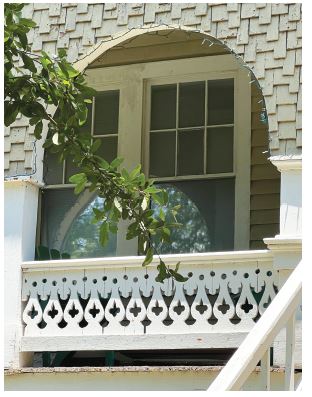
The home featured fish scale boarding, three porches, two fireplaces, nine rooms, and two hallways. A stable and servants’ quarters were constructed at the rear of the property, which was surrounded by a white picket fence.
Homer was constantly branching into different business opportunities. In 1880, he was named as contractor to create a fire alarm telegraph system for the City of Galveston and had the call boxes installed and tested successfully by the end of the year. These type of prospects were quite profitable for the astute entrepreneur.
According to insurance records, the home was rebuilt in 1884, which likely entailed updates that were paid for by Homer’s improved financial situation.
 When the Homers returned to Maine for the summer months in 1885, as they did most summers, their home was advertised for rent, stating it had 10 rooms and a bath. The 1889 Sanborn Fire Insurance map shows the home with a large side yard, brick cistern, and three smaller out-buildings.
Homer was a business associate of Thomas Gonzales (1828-1896), father of Boyer Gonzales (1877-1934), and he arranged for the young, aspiring artist to meet his brother in 1887. The two quickly became friends, with Winslow mentoring the young talent during summers at his home in Maine. Boyer later became one of the island’s most respected painters.
The businessman began the most successful chapter of his career in 1890, when he became president of the new Galveston Rope and Twine Company, operating in a large brick factory that took up half a block on Winnie between 36th and 37th streets. The company imported hemp from Yucatan, using it to create 10 tons of rope or five tons of binder twine daily on 120 spindles.
 In addition to the main factory, the company also had mill buildings and sold timber, Virginia Point brick, lime, cement, cast and wrought iron work, nails, roofing materials, doors, windows, and more at their shop at the far east end of The Strand. Homer’s sons eventually worked for the company as well.
Homer also became president of the Galveston Tinware Manufacturing Company in 1891, whose factory on Avenue A between 23rd and 24th streets manufactured fruit and oyster cans.
Even when he was away from the island, his mind was on its progress and improvement. While on a trip to Syracuse, New York in 1891, he wrote to The News to describe the method of paving streets in brick in detail and suggested the same for Galveston.
When he was appointed vice consul for Uruguay at Galveston in 1892, he unsuccessfully searched the island for a flag of the country and eventually purchased one from abroad. He was the sole representative for businesses from the South American country.
Always innovating to make his factories more successful, Homer was granted a patent for a spool or bobbin holder in 1894.
While Arthur evidently inherited his stern father’s business sense, his older brother Winslow was proving to have inherited their mother’s artistic gifts. His paintings had already received wide acclaim by the early 1880s when he began venturing to warmer climates like Florida and the Bahamas.
The Mallory Lines offered passage between Florida and Galveston at the time and was most likely how the artist traveled to see his Galveston relatives.
A third brother, Charles Savage Homer, Jr. (1834-1917) gave Winslow a small, box-like Eastman Company camera sometime after 1888. Winslow used it to take pictures that were later given to the Rosenberg Library.
The first photo was of his brother’s Galveston home with a pretty woman, a man in a hat, and a small boy looking over a white picket fence - most likely Arthur, Alice, and their youngest child.
The second photo is of two boys and a pony, which corroborates with a family anecdote about Winslow buying a couple of ponies for his nephews during one of his visits to Galveston. That image was taken about 1892 judging by the ages of the boys.
In 1975, the two snapshots of the Homer home and family taken by Winslow were loaned by the Rosenberg Library to the Museum of Fine Arts, Houston to make copies for researchers.
The photographer tasked with making the copies tragically lost the originals and sent a letter of apology to Rosenberg Library supposedly accompanied by new negatives that had been made from them.
Those negatives seem to be missing from the Galveston Texas History Center in the library though, and there is no proof of their receipt. All that remains are grainy photocopies of the originals.
It is exciting to think that the renowned artist may have painted works in the house on Church Street and sketched around the community. Unfortunately, Winslow destroyed all but one of his datebooks and journals as soon as they were filled, so details about the provenance of many of his works are unknown.
Experts believe, however, that at least two of his works and possibly more were created or finished on the island during visits with his brother.
A preliminary 1899 sketch by him was titled After the Tornado, Texas. Once the inspiration became a painting, it was retitled After the Hurricane, Bahamas. Galveston experienced a hurricane in June of that year, and the Great Bahamas Hurricane of 1899 occurred two months later.
At least one sketch in the surviving daybook of watercolors, later exhibited in New York, is also suspected to be created in Galveston.
The Homer home withstood Galveston’s 1900 Storm but the lumberyard was destroyed. There is no record of the home being raised after the storm.
Arthur and Alice remained in Galveston until 1903, when they returned to Maine. That is also thought by researchers to be the last year his famous brother visited the home. Arthur still owned several properties on the island when he passed away several years later.
The next owners of the home operated the property as a boarding house. Among the first boarders were attorney James C. Cany, who would later become a county judge, and Champion Falligant whose name would later appear on the Honor Roll Memorial on Seawall Boulevard as one of the valiant Galvestonians lost in World War I.
From about 1908 through 1921, the main boarder at the home was bachelor John Clark Buckner, a lecturer on botany and pharmacy teacher at the University of Texas Medical Branch, and a 32nd Degree Mason.
He also served as head of the residence that had become a fraternity house for members of the Phi Chi pharmacy fraternity. By that time the home had been redesigned to offer six bedrooms and seven baths.
The home was listed as vacant in the 1924-1925 Galveston city directory. In 1925, records show that David Fahey sold the home to Joseph Walter Paduh, a Polish immigrant.
Paduh and his wife Charlotte initially lived there with their three children, his brother-in-law and a lodger named Ethel Hilton. The former servants’ cottage at the rear of the property was rented to an immigrant couple from Sweden and Germany.
One of the members of the family bred and sold canaries from the home, and occasionally advertised them in the Galveston Daily News.
Gilbert Monson and Josephine Griswold purchased the house from Paduh in 1941, and lived there while renting out rooms to boarders. After her husband’s death in 1953, Josephine remained in the home and rented unfurnished apartments there, including a garage apartment with two rooms and a bath.
The home was listed for sale again in 1990, described as being divided into four apartments in the main house and two garage apartments on the two lots. It was purchased by Gordon R. Boff, who sold it three years later to Brent Elliott Blackett.
The colorful history and ties of the house have been largely forgotten. Now sitting on a corner lot with broken windows on the upper floor, it is more important than ever to remember its historical significance.