When most architecture enthusiasts hear the term “Victorian,” they picture the elaborate, ornate mansions built by wealthy owners - homes adorned with gingerbread trim, asymmetrical rooflines, bay windows, and towers that radiate opulence. But the Victorian era (1837-1901) also produced a more accessible and distinctly American style known as Folk Victorian.
Emerging in the late 19th century, the more modest Folk Victorian allowed middle-class families to enjoy fashionable design by incorporating mass-produced architectural details such as ornamental spindlework, fish-scale shingles, decorative trim, and traditional, simplified floor plans.
While their interiors tended to be straightforward, these homes showcased their charm on the exterior, where the public could appreciate it. They were, in many ways, “Victorian lite” - blending affordability with appealing style.
The charming East End home at 1705 Ball is a beautifully preserved example of the Folk Victorian style. It was built in 1886 by Judge Richard Sheckle Walker (1824-1901), a Kentucky native, and his wife, Eliza Jane Clark (1827-1890), to replace their previous home lost in the Great Fire of 1885, which destroyed a 40-block area of the city.
Walker, a graduate of Centenary College in Jackson, Louisiana, and Transylvania University in Lexington, Kentucky, came to Texas in 1846, establishing a law practice in San Augustine before moving to Nacogdoches in 1848 to partner with his father-in-law, Judge Amos Clark.
He later served eight years as district attorney, became a partner of Judge George F. Moore, chief justice of the Supreme Court of Texas, was a member of the Constitutional Convention of 1866, and was appointed district judge by Governor Richard Coke in 1873.
Though the Walkers primarily lived in Nacogdoches, they used the Ball Street house during court sessions in Galveston and maintained it as their part time residence, keeping it in the family until their deaths.
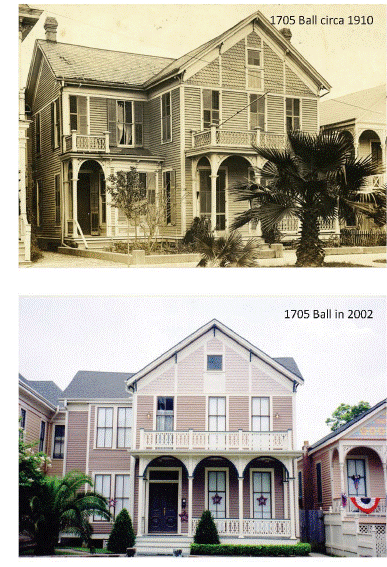
The two-story structure, crowned by a prominent attic, featured steep roof gables, dormers, wood siding, fish-scale shingles, and decorative brackets beneath the eaves. Its original design included a five-bay façade and a gable front porch with jigsawed balustrades and brackets.
The main entrance, fitted with double doors, was topped by a transom light, while a secondary front door on the left side provided access to additional living quarters.
Inside, the home offered hardwood floors, 13-foot ceilings, five bedrooms, a lady’s parlor, a gentleman’s parlor, a kitchen, a dining room, five fireplaces, a single bathroom, and an elegant carved wooden staircase with a gently curved landing.
A small two-story outbuilding stood at the back of the property, with the upper floor likely used as additional living space. The 1889 Sanborn Insurance map notes that the structure had a “stovepipe,” indicating a flue for a stove or chimney, and a cistern was located beside it.
The house survived the 1900 Storm, though it required a new slate roof along with repairs to the flues, plaster, and paint. After Walker’s death in 1901, his son, Dr. Amos Clark Walker (1852-1926), inherited the property and subsequently used it as a rental home.
By 1907, Mrs. Zella Cravens was the landlady of the property. She lived there with her husband, Frank, a bookkeeper at the Rosenberg Bank, and their young daughter.
Their boarders reflected the city’s working-class population at the time, including a railway rate clerk, a clerk in the U.S. engineer’s office, a newspaper editor, a newspaper reporter, a mercantile clerk, and a barber who lived in the rear building.
Walker listed the house for sale in October of that year, advertising it as a “fine, large, two story house,” and noting that the owner was eager to sell.
Aaron Waag (1854-1933) and his wife, Charlotte Auerbacher (1857-1949), purchased the house in 1908. Aaron had recently been promoted from his position as a watchman to an opener and examiner (inspector) in the storekeepers’ department at the U.S. Custom House.
Charlotte immigrated to Galveston from Germany in 1877 and married Aaron the following year at Congregation B’nai Israel in a ceremony led by Rabbi A. Blum. The two shared a similar heritage, as Aaron’s parents were also German immigrants.
The couple raised six children: Henrietta (1879-1937), Solomon Franklin (1881-1950), Pearl (1886-1977), Helen (1895-1974), Ruth (1899-1947), and Benjamin Solomon (1899-1966).
The Waags subdivided the home into six apartments to accommodate boarders in addition to their own large family. They hosted three single women boarders during their first year in the home - a stenographer and former resident of the Galveston Orphans’ Home, a saleslady at Robert I. Cohen, and a bookkeeper. The secondary front door on the left side of the house likely provided access to these quarters.
Solomon’s wife, a milliner known locally as the “St. Louis Milliner,” lived with the family in the house. She operated a shop at 2113 Postoffice (the current location of The Style Co.), offering the latest custom hats, with her sister-in-law Pearl managing the business.
 In 1910, the family sold their Jersey and Holstein cow and heifer calf, likely kept at the back of the property. According to the newspaper advertisement, the cow produced three gallons of milk a day - a practical asset for such a large household.
In April 1913, daughter Helen married James Morris in a daytime ceremony at the home before the couple moved to Dallas. Wearing a tailored grey traveling suit, the bride welcomed guests who had journeyed from as far as Boston to attend.
Pearl’s June 1916 wedding to Daniel S. Stein also took place at the family residence. The local paper described the ceremony as being held beneath a bower of palms, ferns, and white carnations arranged at the north end of the drawing room.
Afterward, guests enjoyed a champagne wedding supper in the home. Following their honeymoon, the Steins returned to the Ball Street house to live with the Waag family.
Henrietta, the eldest daughter, married Louis Ginsburg in 1917 during a quiet ceremony in his hometown of El Paso.
Even as the family celebrated these milestones, they were undoubtedly mindful of the hardships their relatives in Germany faced as World War I unfolded.
A classified advertisement from April 1919 offers a small glimpse into daily life at the home - and into Aaron Waag’s personality. The notice, prompted by missing roses, read: “Wanted: The parties who helped themselves to roses without the consent of the owner. Call again as they are known. A. Waag, 1705 H.” The ad confirms that the family kept a rose garden on the property.
The final Waag wedding held in the Ball Street home took place in September 1922, when daughter Ruth married Julius Weinberg of Houston. The ceremony was officiated by the same rabbi who had married her parents in 1878.
Waag died in 1933 at the age of 79, leaving Charlotte to manage the large home. By the 1940 census, her niece, Theresa Gotshach, and her young grandnephews, Hans and Kurt, were living with her. At that time, the household also included one boarder, Richard Hargraves, an assistant treasurer for a life insurance company.
In 1945, after 37 years in the family, the house was sold to Pierre and Catherine Vignau. Charlotte died four years later, in February 1949, at the age of 92.
Pierre Vignau (1883-1963), his wife, Catherine Josephine Lalanne (1885-1957), and their daughter, Juliette (1921-1984), were natives of France who had moved to Galveston from New Orleans. Pierre had served in the French army during World War I and later worked as a waiter in the French Quarter.
After relocating to the island, he continued in that profession, becoming one of the most popular waiters at the Hotel Galvez for many years.
The Vignaus alternated living in either apartment one or five of the six subdivided flats within the Ball Street home, renting out the remaining units.
Charles McCartney (1892-1965) and his wife, Fannie Cupples (1893-1988), both originally from Louisiana, purchased the house in 1954. In addition to operating a grocery store and farmland in Silsbee, they managed the Ball Street property as a boarding house while living in apartment two.
After Charles’s death, Fannie remained in the home for six more years before relocating to Silsbee in 1971 to be closer to her son and daughter.
In 1973, Jesse Segura purchased the property and restored it to a single family home 18 years later, when the secondary front entrance and its canopy were removed and the front wall was extended toward the street to enlarge the interior. Although the alteration is subtle from the exterior, it resulted in the loss of the secondary side windows that once faced that entrance.
Since its construction, the home at 1705 Ball has passed through the hands of eleven owners, weathered at least seven major hurricanes, and sheltered more than one hundred boarders - its story woven tightly into the fabric of Galveston’s history.
Today, it stands as a three-bedroom, three-and-a-half-bath single-family residence that continues to enhance the beauty and character of the East End Historic District.