Charles Drouet (1870-1932) came from seafaring stock. The son of Sebastian Drouet (1837-1898) - a respected captain who fought in the Battle of Galveston during the Civil War - Charles grew up with salt air in his blood.
By January 1900, he had built his own career along the Galveston waterfront, serving as chief engineer aboard the tugboat Charles Clarke, where he coordinated major salvage operations and helped free large vessels that had run aground along the Texas coast.
On August 20, 1900, he married Mary Wilhelmina Steinhoff (1867-1935), less than three weeks before the historic hurricane that would forever reshape the island.
In the storm’s aftermath, skilled salvagers were in high demand. Drouet partnered with Charles Bryant to form Drouet & Bryant Salvagers, establishing their office at 2118 The Strand.
The city contracted them to clear dangerous wreckage from Galveston Bay - a critical effort that involved removing barges, schooners, and even a steam vessel that obstructed navigation.
The work was steady and well paid. By May 1903, Drouet had earned enough to build a charming cottage for himself and Mary at 1003 Sealy.
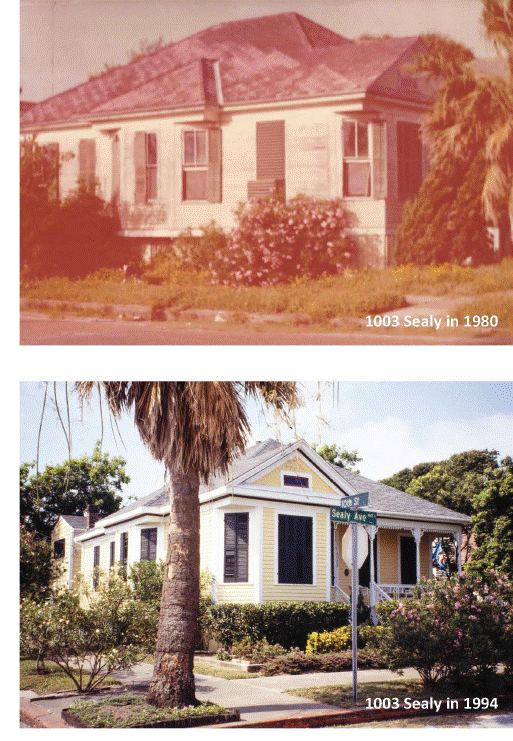
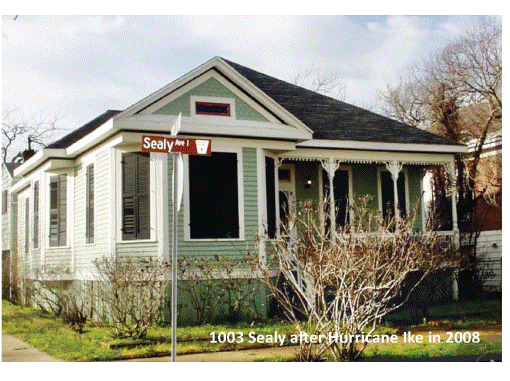
The one-story Queen Anne cottage was richly detailed for its size, featuring decorative fish-scale siding, Chippendale balustrades, and spindlework trimmed with lace brackets. Inside, modern conveniences of the day - electric lighting and a gas stove - complemented the home’s traditional craftsmanship.
The five-room layout included a central hall, transomed interior windows, longleaf pine floors, a walk-in pantry, and a bathroom, with porches at the front and back to catch the Gulf breezes. Two bay windows filled the rooms with natural light and ventilation, and a 10-by-12-foot chicken house stood at the rear of the property.
Drouet’s career continued to evolve. By 1905, he was working as a machinist at the island’s military forts, and the following year he became a steamfitter, opening his own business at 113 20th Street supplying materials for steam and gasoline engineers.
Around 1908, Mary’s widowed mother, Marie Steinhoff, briefly moved in with the couple - one of several of her children’s homes she rotated among in her later years.
As Galveston’s shipping industry shifted inland to Houston, Drouet followed the work. In November 1908, he announced that he was leaving the island and offered his machine shop on Twentieth Street for sale, which was quickly purchased by R. L. Bettison.
The following March, the Drouets listed their home for sale or lease and sold their four wheel spring wagon and motorized Runabout automobile before relocating to Houston. Even after the move, the couple maintained strong ties to the island. Drouet continued to invest in Galveston real estate well into the 1920s.
For the next decade, the house was occupied by a series of renters, beginning with David A. Burchfield (1887-1920) of Arnold & Burchfield Dentists, whose office was located in the City National Bank Building.
He lived in the cottage from 1909 to 1910 with his wife, Irena Mae Melville (1885-1967), their daughter Dorothea Mae (1907-1978), and David’s brother, Robert Ottis Burchfield (1889-1966), who worked as a statistics clerk for the Santa Fe Railroad.
By 1913, the small home was filled to capacity. Its residents included Mary Jane Staunton McFadden (1850-1918), an Irish immigrant and widow of bartender Joseph Patrick McFadden.
Living with her were her daughter, Mary Agnes (1876-1946), Mary Agnes’s husband, Sidney Virgil Patrick (1874-1964), and their four young children - Eleanor, Sidney, Hubert, and Austin. Sidney supported the household as a traveling salesman, and the family moved out in 1914 as they prepared to welcome their fifth child.
Later that year, the cottage was rented by Edward Austin Pond (1865-1933), a bookkeeper, and his wife, Julia Prendergast (1860-1942), a stenographer. Pond would go on to become an authority with the Port of Galveston.
Danish immigrant Alfred Christian Fredericksen (1869-1945) moved into the home in 1916. He operated the Port Bolivar Ferry Service as captain of the launch Silver King, but by the time he rented the cottage, he had already endured profound personal loss.
His first wife, Emma H. Dubree (1868-1900), and two of their three children - Viola Olivia, age nine, and infant Alfred - perished in the 1900 Storm. Only Fredericksen and his middle son, Albert William (1895-1917), survived. The bodies of their loved ones were recovered and interred in January 1901.
Later that year, in December 1901, Fredericksen married Elizabeth “Lizzie” Bailey (1884-1911). They had four children together: Clarence Carl (1903-1984), Robert (1905-1983), Irene Eleanor (1907-1970), and Edwin (1909-1911).
Tragedy struck again when Lizzie died in April 1911 of a heart infection, and their youngest son, Edwin, passed away from measles the following month.
Now a widower with four surviving children, Fredericksen married Mary Margaret Bailey (1887-1958), Lizzie’s sister, in May 1912. This marriage brought five more children, two of whom had been born by the time the family moved into the cottage: Alfred Sherwood, who died in infancy in February 1913, and Lawrence, born in 1914.
In 1917, just a year after settling into the home, Fredericksen suffered another loss when his 21-year-old son Albert - the only surviving child from his first marriage - died of nephritis in the house.
By 1919, the growing family needed more space, and they moved to a slightly larger home on Avenue N ½. Three more children would be born to the couple over the next six years.
Anna I. Buhmann Moor (1873-1970), the widow of Dr. Henry Purris Moor, rented the Drouet cottage in 1919. The home was conveniently located just two blocks from Rosenberg School, where she taught.
She lived there for about two years with her five children: Joel Wythe (1902-1947), Edwin Austin (1904-1966), Elizabeth “Libby” Katherine (1906-2003), Charles Manly (1907-2002), and Florence Imogene (1910-1964).
Another widow soon made the cottage her own. In 1921, Austrian immigrant Stanka Agin, born in 1870, purchased the property and moved in with her son, Dr. George Agin Jr. (1897-1924), a dentist. She had recently retired from running a grocery store at 827 Winnie - a building that still stands today.
Stanka carried with her the grief of losing her husband and two young children, Lawrence (age 11) and Mare (age 4), in the 1900 Storm.
By the time the Agins arrived, a secondary structure had been added at the rear of the property. It was occupied by William Basford, a car inspector for the Gulf, Colorado & Santa Fe railyard, and his wife, Olga.
After the untimely death of her last surviving son in 1924, Stanka sold the property to Swedish immigrant Thure Reinhold Jacobson (1902-1992). Jacobson leased the main cottage to truck driver Jap Edward Godbehere (1888-1969) and his wife, Mary Margaret Sedler (1894-1987), while the back building was rented to William Claussen, a police department janitor, and his wife, Edna.
Jacobson, who worked as a clerk with the Marine Corps of Engineers, married Galveston native Marie Myrtle Stickhausen (1904-1955) on May 27, 1925. After their honeymoon, the newlyweds moved into the cottage themselves.
A small piece of history remains at the edge of the property: the front sidewalk bears the stamp of Matali & Son cement workers, who likely installed that section of walkway around 1931 - just after the Jacobsons had moved out of the house.
 From 1932 to 1937, the cottage was rented by James George La Coume, owner of La Coume Bakery at 1921 Market Street. The lively household included his wife, Lucille Marie Rizzo (1893-1987), and their children - Dolores, Leonora Marie, James George, Jerry, and Shirley Mae.
Short-term boarders followed. In 1938, the home was rented by Michael D. Quin, a clerk with the Gulf, Colorado & Santa Fe railyard, and his wife, Helen. They were succeeded in 1939 by Joseph R. Miller, a restaurant cook, and his wife, Lillian, who later moved to a larger property where they could take in boarders of their own.
From 1941 to 1944, the cottage was leased by Yugoslav-born Matt N. Antichevich (1892-1971), a custodian for the school district. He lived there with his wife, Catherine Theresa Lowth (1902-1975), and their children - Anne, Nicholas, Jean Marie, and Mary Agnes.
 The cottage was advertised for sale in December 1946 as being in “splendid” condition, complete with modern conveniences and a garage. It was purchased by John Lindsey Whitesides (1920-1973), who resold the property just a few months later, in March 1947, to Victor Halstead Neal (1904-1974).
Neal was an accomplished pianist and music teacher. As a student at Ball High School, he worked as an organist at the Dixie No. 3 Theatre and later at the Queen Theater.
After graduation, he earned a scholarship to the University of Texas but instead chose to continue his studies in Washington, D.C., where he spent twelve years with the Washington College of Music - first as a student, then as a member of the faculty.
When Neal returned to Galveston and purchased the cottage, he opened a piano studio in the front room, accepting a limited number of adult and child students at both beginning and advanced levels. His reputation was such that prospective students were interviewed before being accepted for instruction in piano, organ, music theory, or voice repertoire.
In addition to teaching, Neal performed concerts locally and served as an organist for several congregations, including First Methodist Church.
In his later years, Neal donated a collection of roughly sixty pieces of Lalique crystal - bowls, vases, perfume bottles, and figurines - to the Rosenberg Library in memory of his mother, Martha Malvina “Mattie” Halstead Neal, and two of his aunts. After his death, his beloved Steinway piano was offered at the auction of his estate in October 1974.
By then, the cottage was seventy years old and in need of care. Its new owners, William Joseph Foley (1929-2012) and his wife, Mary Bernadette Simpson (1934-2020), stepped in with a thoughtful restoration that earned the home a place on the Galveston Historical Foundation’s Homes Tour in 1990.
A 1991 edition of the East End Historic District newsletter welcomed the Foleys as “new neighbors,” noting that they had finally moved in after completing the long renovation. They remained active supporters of the Galveston Historical Foundation and other community organizations for many years.
Today, the cottage has been fully updated once again - from plumbing to décor - and is offered as a charming short-term rental for visitors exploring the island. Reimagined as Shamrock on the Shore, the home honors its early history with thoughtful interior details, including a portrait of the Drouets in the dining room.
It’s remarkable how many stories one small cottage can hold.