East End Historic District Association members recently accomplished a “refresh” of the Victor Gustafson Cottage they use as their community house. This is especially impressive because it was performed with a tight budget and a whirlwind timeline.
The raised, one-story cottage at 1501 Postoffice and the site where it sits represent multiple chapters of island history.
An earlier structure occupied the ground, as did a slave market. After the Civil War, a carpenter’s shop used the slave auction block as a foundation for its business.
In 1918, Edmund J. Cordray operated a pharmacy and general store there. That structure was torn down several decades after falling into disrepair, and the lot remained vacant for years.
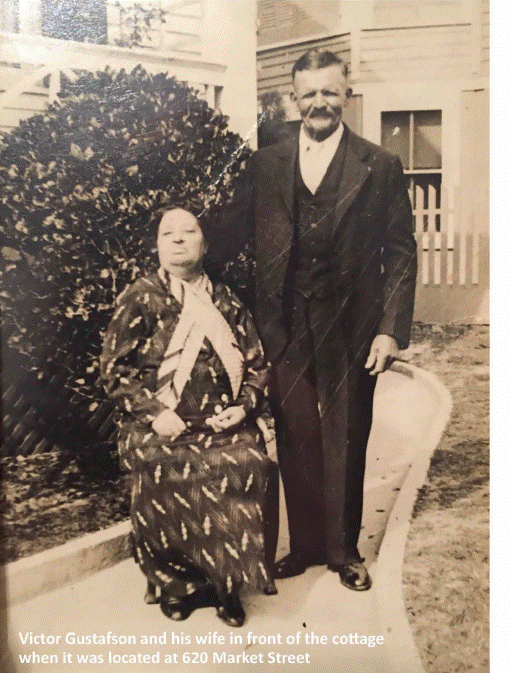
In 1895, Victor Gustafson (1870-1956), an immigrant from Finland, built the cottage that currently sits on the Postoffice location at 620 Market Street. Employed as a screw man in the cotton industry, he built the house by hand. It originally had two rooms divided by a single-thickness wall, with a small attached kitchen.
He and his wife, Olga Sandberg (1873-1897), had two children, Jennie V. (1893-1954) and John V. (1895-1921), before Olga passed away at the age of 24.
Five months after losing his first wife, Gustafson married Maria Louise Lindgren (1873-1935) with whom he had an additional nine children: Hazel Marie (1898-1948), Hilda Viola (1900-1962), Evelyn (1904-1967), Wesley C. (1905-1969), Marguerite (1908-1969), Frederick S. (1910-1961), Julius G. (1913-1989), Victoria L. (1916-1992), and Wilford F. (1917-1984).
The home was partially destroyed in the 1900 Storm but was repaired and improved. In 1922, Gustafson enlarged the house by adding a room to the back of the building to better accommodate his large family.
The home at 620 Market Street was purchased in 1970 but stood empty for eight years before being resold.
The frail cottage was moved to its current location on Postoffice in February 1979, and the EEHDA later restored it with funds from the Community Development Block Grant Program, The Moody Foundation, and proceeds from volunteers’ participation in community events.
During the initial restoration, volunteers discovered the original tin roof underneath a more recent one and removed two small additions from the 1940s and 1950s at the rear that were in poor condition.
They also removed the central wall of the home, creating one large room to use as a gathering space. The ghostly imprint of that wall can still be seen on the original long-leaf yellow pine floor just to the left as visitors enter the home.
The 1922 addition was converted into a modern kitchen and bathroom. The small original kitchen, first used as an office by the association, now serves as a storage space for chairs, tables, and decorations. A door inside the space that would have initially led to a back porch now opens into the HVAC closet.
Though charming, the cottage’s interior had not been changed since its initial move to the East End, and members decided that the district’s 50th anniversary was a perfect time for an update.
Christine “Chris” Glover, president of the EEHDA, and board members Alyson Poston and Susan Alexander, an interior designer, led the effort in what became an actual community labor of love.
“We were on a strict budget,” shares Poston, “but we had some amazing donations. The local franchise of CertaPro Residential Painting donated all the paint, and Sunset Homes, a local contractor, donated nine days of labor.”
The women were more than organizers of the effort – they were also hands-on, along with a small crew of volunteers.
“So much had to be scraped and sanded,” shares Glover, “and I don't think anyone estimated that these walls hadn't been painted since the eighties. The walls just soaked up the paint, even though we used four or five cans of KILZ primer; it took much more than originally estimated.”
“The cost of the donated paint alone would have retailed at about $4,000,” adds Poston.
 Luckily, after a thorough cleaning and closer inspection, the original wood floors revealed themselves to be in surprisingly good shape, preserving a key piece of the home’s historic character.
More electrical outlets were added, and outdated 220V AC power was upgraded pro bono by Shane Beall of A&H Electric, enhancing the entertaining capabilities of the great room. The ladies had received one bid for this work at $2,600, so Beall’s donation made the upgrades possible even with their strict budget.
“We were actually able to have seven crockpots plugged in at the same time for an event for our first responders in October,” smiles Glover.
To address the lack of lighting after dark, the team had recessed can-style lights installed in the great room.
“It just makes it so bright in here now,” Poston sighs in relief. “If we had meetings or events in the evening, people would sometimes use their phone lights to read notes!”
Upon entering the small cottage, visitors see a breathtakingly serene wallpaper mural view of a harbor landscape with sailboats, in muted tones of blue and green.
“It's called Safe Harbor,” explains Alexander, “which I think is appropriate for Galveston. It’s from a company that uses a tool called Mural Source.”
“Many of their murals are priced in the thousands, but this one was just $321. It’s 12 feet wide by 10 feet tall, which is cut down a bit from its original size to fit the space.”
“The mural gives the room so much more depth,” adds Glover.
 Local carpenter Floyd Pollock created an entry table with gently curved legs that accent the elegance of the composition. To set it off, Alexander’s husband, Robert, installed picture-frame molding on each side of the mural space.
The walls are adorned with newly framed black and white historic photos from the neighborhood, as well as prints of sketches of historic Galveston structures commissioned by Cynthia Mitchell in the 1980s.
“All of the furniture has been reupholstered and restuffed,” says Glover, pointing out various pieces in the gathering space. “The cloth chairs have been restored, and what we thought were leather seats - but found out were oil cloth - we refurbished as well.”
Ten-inch-tall baseboards are considered original in the large room, but the chair rail and picture molding higher on the walls are thought to have been replicated in the 1980s renovation.
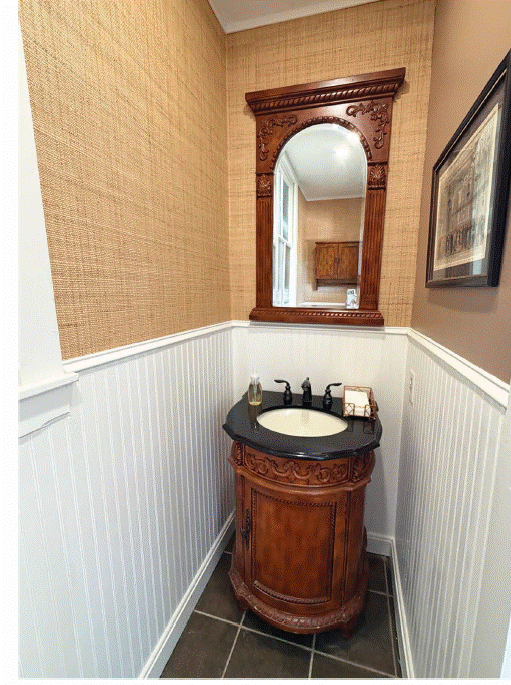
A small, dark, cramped bathroom is now furnished with attractive accessories. The walls have been brightened with a light grass cloth that Alexander had left over from another project.
The kitchen was refreshed and deep cleaned, including hand-scraping a sealant that was painted on the tiles decades ago. Crisp curtains of blue and white ticking now hang from the windows, which required extensive repair.
As an interior designer, Alexander works in many historic homes and values maintaining their aesthetic.
“I always tell clients that these homes were new once, fresh, and updated. We needed to refresh this cottage to give it a current feel, but keep the history,” she explains.
“I think that's part of what we have to do,” states Glover, “is to hold onto the fact that the whole association started as a grassroots kind of neighborhood vision and preservation.”
Referring to the historic district, Alexander muses, “We're the stewards of all of these homes. They're not going to be ours forever. The key is keeping the structures maintained.”
The association members worked tirelessly to complete updates in time for the EEDHA Fall Garden Tour, the first time the public saw the updates.
 The surprising answer came from Glover when asked how long the project took to complete. “Five weeks. I'm telling you a lot of long hours, but we got it done in five weeks.”
Thinking of all that was accomplished with the project, Alexander says, “What these folks did, I mean, they're saints. If this had been contracted out, it would have been a $30,000 job.”
In addition to using the charming cottage for their own functions, the association offers it for use to others in exchange for a small donation. It’s an ideal setting for meetings, baby showers, and bunco games, and occasionally serves as a bride’s changing space for weddings held at Darragh Park.
Visitors are invited to visit the Gustafson and four other historic homes in the neighborhood during the EEDHA Christmas Homes Tour on Friday, December 5. The tour has been compared to the opportunity of walking around in a Hallmark movie set. For details and ticket information, visit eastendhistoricaldistrict.org.