Why is it that some beachcombers seem to stumble upon sand dollars with ease, while others search for years without spotting a single one? The answer lies in more than just luck.
To improve your odds, it helps to understand what sand dollars are, where they tend to hide, and when conditions are just right for discovery. Add in a touch of folklore and mystery, and it’s easy to see why these delicate treasures have captured the imagination of seaside seekers for generations.
A sand dollar is actually the skeletal remains of a living keyhole urchin, a sea creature that thrives offshore in sandy-bottomed areas typically beyond the beach’s foreshore and along the third sandbar. These urchins move in dense colonies, sometimes stacking atop one another as they filter-feed on plankton and organic matter.
Occasionally, a live keyhole urchin washes ashore. It appears dark brown or purplish and is covered in tiny, hair-like bristles called spines.
If you spot one, admire it briefly but don’t take it. These creatures can only survive a few minutes out of water, so the kindest thing you can do is gently return them to the sea.
Once a keyhole urchin dies, its spines fall away, leaving behind a smooth, light brown skeleton known as a test. These tests often wash ashore, carried in by tides and currents, where beachcombers may find them nestled in the sand.
Cold water is one of the leading causes of death, which is why winter is the best time to find intact sand dollars along the shore. Summer visitors may get lucky, but these delicate treasures are far more common in the cooler months.
My go-to tools for successful sand dollar hunting are simple but essential: a weather report and a tide chart. I print a fresh tide chart each month, and local bait shops often carry pocket-sized versions that are easy to keep on hand.
The real magic happens when you combine tide data with cold-weather forecasts. Timing is everything.
I focus on the lowest daylight tides each month, aiming to walk as far out as possible, ideally reaching the third sandbar where keyhole urchins tend to gather.
 Once I’ve pinpointed the lowest tide windows, I check the weather. Forecasts are typically reliable up to a week out, and if a storm rolls in with strong northern winds and freezing temperatures during low tide, it can push the surf back dramatically. That extra exposure gives me access to areas that are usually underwater.
When the water gets cold enough, keyhole urchins may die off, and their skeletons, known as sand dollars, begin to wash ashore. It’s a delicate balance of timing, temperature, and tide, but when conditions align, the shoreline can reveal a surprising bounty.
As I walk, I often spot broken pieces of sand dollars scattered along the shore - jokingly called “spare change” because they’re about the size of a quarter or half-dollar.
Their presence tells me the surf has been rough enough to knock the keyholes from the bottom, and many of the urchins have likely succumbed to the cold. This stretch of beach usually yields good finds when conditions are right.
Not every shape in the sand is what it seems, though. Sometimes, I mistake the circular mounds made by ghost shrimp for sand dollars. They can look deceptively similar at a glance.
To tell the difference, I look for the five distinct petal-like markings on the top of a sand dollar’s shell. Most are partially buried, so I gently brush away the surrounding sand to see if it’s whole or just another piece of spare change, always racing the next wave before it washes my find away.
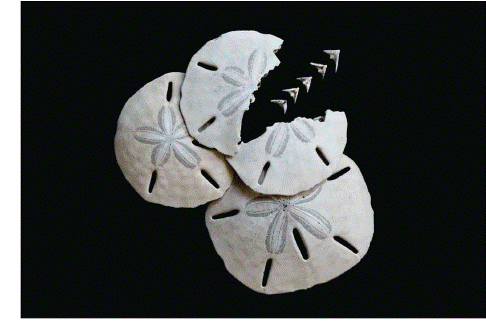 After finding a sand dollar, careful handling is essential. I’ve cracked more than a few by slipping them into a pocket or tossing them in with shells, only to find them shattered later.
They’re incredibly fragile, especially the tiny ones no bigger than a nickel. To keep them safe, I carry a small tin in my jacket pocket reserved just for sand dollars.
Once I’m home, I place them on the kitchen windowsill to dry, where they can harden undisturbed and stay intact - a quiet little reward for a well-timed walk along the shore.
If you happen to break a sand dollar, take a moment to look closely - you may find five tiny, white fragments shaped like doves. These are actually the sand dollar’s jaw bones, joined in a circular formation inside the shell. When separated, they resemble delicate birds in flight.
According to the Legend of the Sand Dollar, this fragile shell carries deep Christian symbolism. The five-pointed star etched on top is said to represent the Star of Bethlehem, while the five holes symbolize the wounds of Christ - four from the nails in His hands and feet, and one from the spear.
Surrounding the star is an outline that resembles an Easter lily, a symbol of resurrection and renewal. On the underside, some see the shape of a poinsettia, tying the legend to Christmas as well.
When the sand dollar breaks open and the five doves are released, they are believed to carry a message of peace, hope, and goodwill to the world.
It’s a fitting end to a quiet walk along the shore, where science meets symbolism and a simple shell becomes a reminder of nature’s grace and mystery.
Whether you find one whole or in pieces, the sand dollar offers more than just a keepsake. It’s a story waiting to be discovered.