I’ve been an advocate for Great White sharks for most of my life, long before I ever lived near the ocean. I’ve always felt they got an unfair reputation, especially after the movie Jaws premiered in 1975 and convinced an entire generation that these animals were something to fear.
The film sparked decades of misunderstanding, and for a time it even fueled efforts to kill Great Whites rather than protect them.
Today, Great White sharks have been a protected species for roughly fifty years, yet poaching still happens because of the demand for their teeth. Buying a modern Great White tooth is illegal in most places for that very reason.
But finding a fossilized Great White tooth on the beach - something naturally shed millions of years ago - is completely legal, and discovering one remains the biggest thrill I’ve ever had as a beachcomber.
It’s very rare to find Great White shark teeth in our area. It’s not because Great Whites aren’t in the Gulf - they absolutely are - but their teeth simply don’t turn up on our beaches very often.
Instead, we’re far more likely to find teeth from more common species such as bull, tiger, and mako sharks. Bull shark teeth, in particular, are the ones we see most frequently along our stretch of coastline.
When I found my first Great White tooth fossil on the beach, it instantly became my most prized beachcombing treasure. A year later, I found a second one. In more than twenty years of searching, I’ve never found another.
Every time I hold those two teeth, I think about the sharks they came from and the questions that ran through my mind the moment I discovered them.
One of the things that fascinates me most about finding shark teeth along the Gulf Coast is how far they’ve traveled through time and geology to reach our beaches.
Millions of years ago, this entire region was covered by warm, shallow seas filled with sharks of every size. As sea levels rose and fell, layers of sediment buried their shed teeth, preserving them in ancient deposits deep below the surface.
Today, storms, strong currents, and even offshore dredging can expose those older layers and carry fossilized teeth into the surf. Longshore currents then move them along the coastline until they finally wash ashore.
That’s why some beaches seem to produce more fossils than others - it all depends on how those ancient sediments are stirred up and where the currents decide to drop their treasures. Every tooth that reaches the sand has survived an incredible journey through time, water, and geology before ending up at our feet.
All sharks naturally lose teeth throughout their lives. Great Whites have around 300 teeth arranged in five rows at any given time.
Only the front row - the teeth you’d see if a shark could smile - is used for feeding. The rows behind them lie flat and move forward like a conveyor belt, replacing any tooth that chips, breaks, or falls out.
This constant rotation ensures the shark always has a sharp, functional set of teeth. Over a lifetime, a single shark can lose as many as 10,000 teeth - which is a big part of why we’re able to find so many fossilized shark teeth on our beaches today.
Great White (Carcharodon carcharias) teeth are easy to recognize by their coarse serrations, sharply triangular shape, and thick, squared-off root.
After finding my two fossilized Great White teeth, I couldn’t help wondering what they might reveal - how big the sharks were when those teeth were shed, how long ago it happened, and why the enamel now shows such striking colors instead of the pure white it once had.
To answer my first question, scientists use a simple 10-to-1 formula to estimate the length of a Great White based on the size of a tooth. For every inch of tooth - measured from the center of the enamel edge to the tip - the shark is estimated to have been about ten feet long.
This ratio comes from years of tagging, measuring, and releasing Great Whites, allowing researchers to compare tooth size with overall body length.
The upper tooth I found measured 1⅛ inches, but because the tip is missing, I estimated it would have been about ¼ inch longer when it was whole. That puts the original tooth at roughly 1⅜ inches, meaning the shark it came from would have been about fourteen feet long - a big animal that was still growing and shedding teeth.
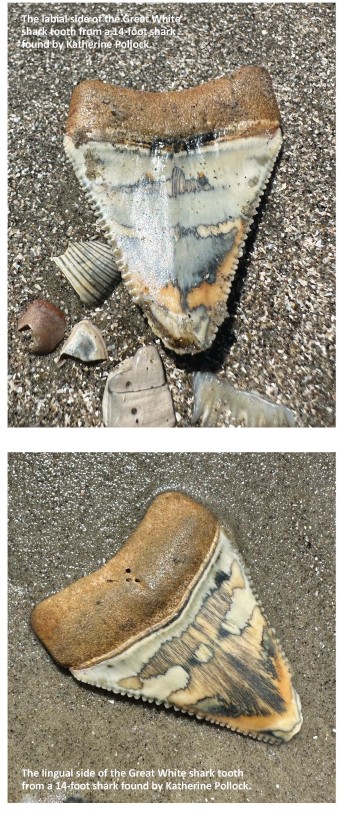 The second tooth I found has the tip intact and measures exactly one inch, which corresponds to a ten-foot shark. It’s important to note that this formula applies only to Great Whites; other shark species have different proportions and tooth-to-body ratios.
My second question was the most puzzling. When a shark tooth fossilizes, it changes color based on the minerals it absorbs from the surrounding sediment.
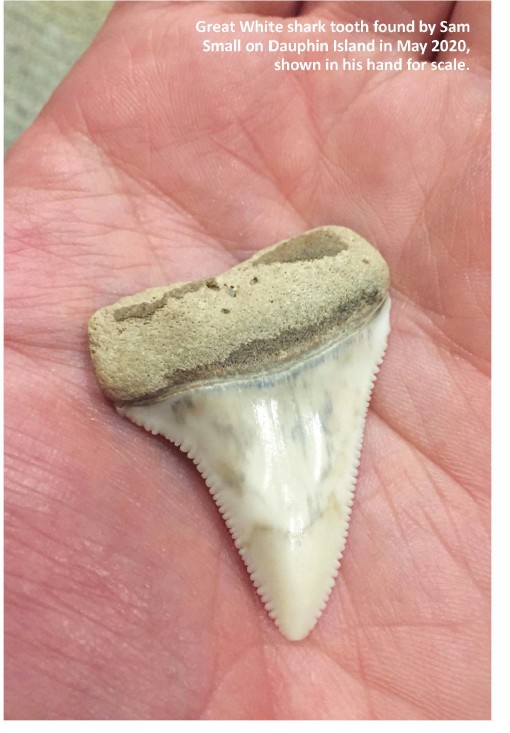 Along the Gulf Coast, most of the shark teeth we find are black, which means they absorbed a high amount of phosphate during fossilization. But both of my Great White teeth have multiple colors.
One tooth shows tan, black, gray, and orange. The other is mostly black on the lingual side (the inside of the mouth) with orange-speckled serrations on the labial, or “smile,” side.
The orange tones come from iron oxide in the sediment. Speckles and streaks can form when plant roots grow near the tooth or when nearby organic material decays during the fossilization process.
Some colors can even develop long after fossilization, as the tooth moves around on the ocean floor for hundreds or thousands of years. Judging by the variety of colors in both of my teeth, they’ve clearly traveled a long way and absorbed minerals from many different environments.
Determining the exact age of a fossil isn’t an exact science. Along the Gulf Coast, most shark teeth range from about 2 to 20 million years old, dating to the Miocene and Pliocene epochs.
Some can be younger - anywhere from 10,000 to 1.8 million years old - placing them in the Pleistocene. I can’t say with certainty how old my two Great White teeth are, but whether they’re thousands or millions of years old, they remain my most treasured beach finds.